



 English


LED display color temperature — measured in Kelvin — controls whether your screen appears warm-white, daylight-neutral, or cool-blue. It directly determines color accuracy, viewer comfort, and camera compatibility. Specifying 9300K for a broadcast studio instead of the D65 standard (6500K) introduces a ΔE color shift of 5–8. That exceeds the human-visible threshold of ΔE 3, and no post-production correction fully recovers it. This guide compares 3200K, 6500K, and 9300K with quantified performance data, a scene-matched selection matrix, and a four-method verification framework for your next LED display specification.
Quick Comparison: 3200K vs 6500K vs 9300K
| Specification | 3200K | 6500K (D65) | 9300K |
|---|---|---|---|
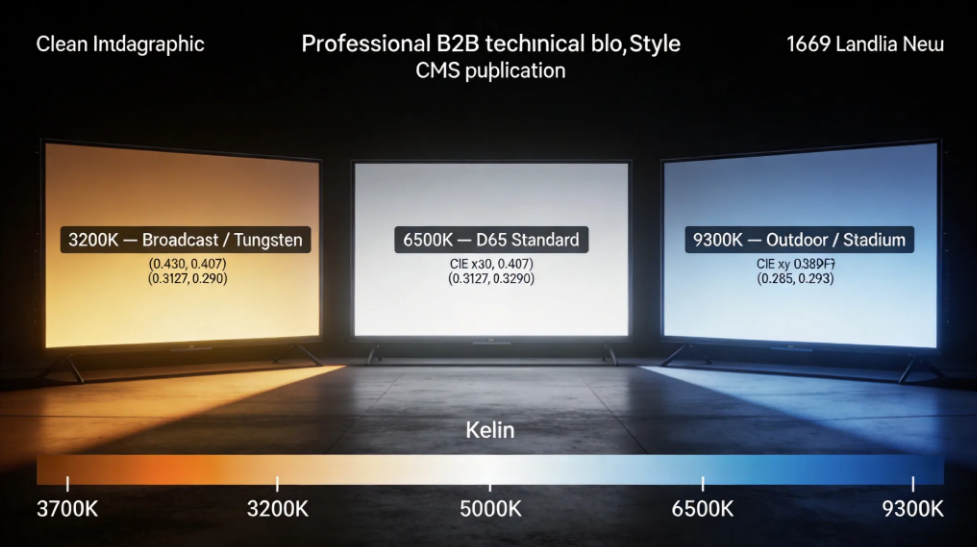
| Color Appearance | Warm yellow-white | Pure neutral white | Cool blue-white |
| CIE xy Coordinates | x≈0.430, y≈0.407 | x=0.3127, y=0.3290 | x≈0.285, y≈0.293 |
| Industry Standard | ★★★ Broadcasting | ★★★★★ IEC / ITU / DCI | ★★☆ Outdoor only |
| CRI Typical Range | 85–95 | 80–92 | 70–82 |
| Camera / Broadcast | ✅ Tungsten match | ✅ Universal D65 | ⚠️ AWB out of range |
| Brightness Perception | 8–12% softer than actual nits | Baseline reference | 10–15% punchier than actual nits |
| Color Drift (5yr) | Low | Lowest | High — Blue channel fades fastest |
| Best Use Case | Broadcast studio · Control room | Billboard · Exhibition · Stage | Sports arena · Outdoor screen |
? D65 (6500K) is the white point defined by IEC 61966-2-1, ITU-R BT.709, and DCI-P3. When in doubt, specify D65 (6500K) — it is compatible with every professional display and camera workflow.
? Color temperature is set by the RGB current ratio in the driver IC. Post-installation software adjustment is available within ±500K of the factory preset.
What Is LED Display Color Temperature?
LED display color temperature is not a measure of physical heat. It is a Kelvin number that describes the hue of white light your display produces. Think of a steel rod heated in a forge: it glows orange-red at low temperatures and blue-white at extreme heat. Color temperature borrows that physical relationship to describe light hue — without any actual heat involved.
In LED displays, white light is generated by mixing direct-emitting Red, Green, and Blue sub-pixels. Each pixel contains discrete R, G, B LED chips whose combined output produces the displayed color. The RGB current ratio set by the driver IC determines the output color temperature:
Increase Red, reduce Blue → color temperature drops (warmer) Increase Blue, reduce Red → color temperature rises (cooler)
Remember this key point.: The three ranges that matter for procurement:
2700K–3500K: Warm white — orange-yellow cast, matches tungsten/halogen stage lighting 5000K–7000K: Daylight neutral — D65 (6500K) sits here, matches natural daylight ≥8000K: Cool white — blue-white cast, high perceived contrast, exceeds most camera AWB limits
⚠️ Critical distinction: Color temperature and brightness are independent specifications. A 6500K panel and a 9300K panel at identical nits settings measure the same luminance. The 9300K panel appears 10–15% brighter because short-wavelength blue light stimulates rod and cone photoreceptors more intensely. Never use "cool = brighter" as a selection criterion.
White Balance and Color Temperature
White balance is the prerequisite that makes color temperature accurate — and the specification most often absent from supplier spec sheets.
Think of white balance as the "true white" reference point for your display. When correctly calibrated, every color the panel produces renders accurately. When white balance drifts — due to LED aging, temperature changes, or dust accumulation — color temperature shifts with it. A panel factory-set to D65 (6500K) with drifted white balance may display visually as 5,800K or 7,200K with no change to its driver settings whatsoever.
The technical indicator is the CIE chromaticity coordinate pair (x, y). If those coordinates shift beyond ±0.006 from the target white point, the color error (ΔE) exceeds the human-visible threshold of ΔE 3.
Procurement implication: Reputable manufacturers calibrate white balance before shipment. After 12–24 months of continuous operation, differential LED channel aging shifts white balance measurably. Budget for annual professional recalibration — approximately $0.30–0.80 per module — to prevent visible color inconsistency across multi-panel installations.
Why D65 Is the Industry Reference
D65 is not a preference — it is the white point mandated by three independent international bodies:
IEC 61966-2-1: governs consumer and professional display devices ITU-R BT.709: governs broadcast production DCI-P3: governs digital cinema
All three converge on CIE coordinates x=0.3127, y=0.3290. A D65-calibrated display feeds directly into any professional post-production pipeline without a white balance correction step. A 9300K display requires a 2,800K color-shift correction toward warmer tones that reduces usable color gamut by 6–12%. The practical rule: if any camera will point at your display, D65 is the only defensible specification.
How LED Display Color Temperature Affects Performance
Choosing the best color temperature for outdoor LED displays is a fundamentally different decision from choosing for indoor or broadcast use. Each environment demands a different Kelvin value for a different technical reason. Color temperature affects three measurable performance dimensions: brightness perception, camera compatibility, and long-term color stability.
Brightness Perception vs Actual Nits
Actual luminance (nits) is a hardware-measured absolute. Perceived brightness is what your audience experiences — and the two values diverge significantly across color temperatures:
9300K stimulates short-wavelength photoreceptors more strongly, making displays appear 10–15% brighter than measured nits suggests — useful for outdoor screens competing with direct sunlight D65 (6500K) delivers brightness that matches measured nits — the calibrated baseline for all professional comparisons 3200K appears 8–12% softer than measured nits — preferable for control rooms and broadcast sets where operators work 8+ hour shifts
For outdoor installations, 9300K's brightness advantage partially reverses in high-ambient daylight. The blue component merges with a blue-sky background, reducing perceived contrast at viewing angles above 30° from perpendicular.
Camera Compatibility and Long-Term Stability
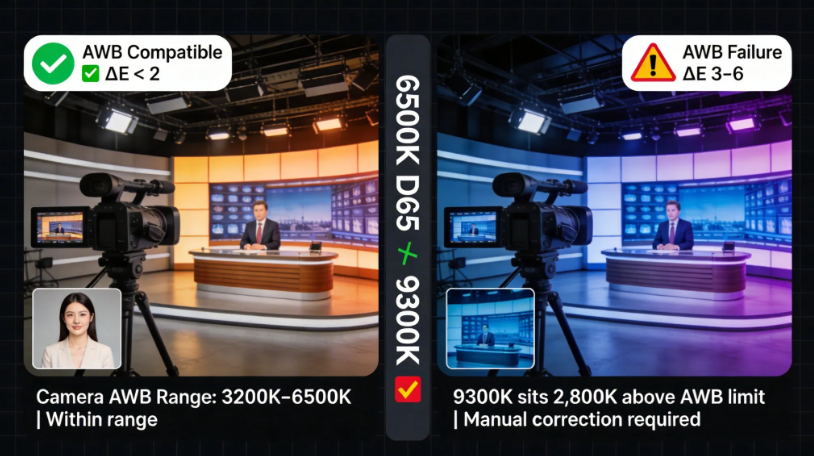
Professional camera Auto White Balance (AWB) systems operate between 3200K and 6500K. A 9300K display sits 2,800K above that upper limit. The table below maps every major installation type against the correct color temperature, camera ΔE risk, and the CIE reference coordinates for verification:
| Installation | CCT | AWB | Camera ΔE | CIE x / y | Δxy Limit |
|---|---|---|---|---|---|
| Broadcast studio background | 3200K | ✅ Tungsten | ΔE < 2 | 0.430 / 0.407 | ±0.008 |
| News set / Interview backdrop | D65 (6500K) | ✅ D65 | ΔE < 1 | 0.3127 / 0.3290 | ±0.006 |
| Outdoor live event stage | D65 (6500K) | ✅ Daylight | ΔE < 2 | 0.3127 / 0.3290 | ±0.006 |
| Sports arena main screen | 9300K | ⚠️ Manual WB | ΔE 3–6 | 0.2848 / 0.2932 | ±0.006 |
| Concert / Touring LED wall | D65 (6500K) | ✅ Mixed cam | ΔE < 2 | 0.3127 / 0.3290 | ±0.006 |
Long-term color stability follows the same pattern — and it compounds the camera compatibility issue over time. LED displays experience differential channel aging: the Blue channel degrades 15–20% faster than Red and Green over 50,000 operating hours, a direct consequence of direct-emitting blue LED chips deteriorating faster under sustained high drive currents.
9300K panels require higher Blue channel drive current and drift toward warmer temperatures faster than D65 panels 3200K panels drift cooler as Red channel output declines faster in warm-white configurations D65 (6500K) panels operate with balanced RGB drive current and exhibit the most stable long-term color temperature of all three options
For projects with a service life exceeding five years, D65 (6500K) represents the most cost-effective maintenance option.
How to Choose the Right Color Temperature
The most common procurement error is treating LED display color temperature as an aesthetic preference. The correct framework evaluates five variables in sequence before committing a Kelvin value to a contract.
Step 1 — Identify ambient light color temperature Match the display to the dominant light source in the environment:
Tungsten / halogen stage lighting (3,000–3,400K) → specify 3200K Mixed indoor LED / fluorescent (4,000–5,000K) → specify 5000K–6500K Outdoor daylight dominant → specify D65 (6500K) Dark venue / night-only outdoor → specify D65 (6500K) as neutral baseline
Step 2 — Confirm camera or broadcast requirements Any professional camera filming the display triggers a D65 (6500K) requirement — unless the studio uses exclusively tungsten lighting, in which case 3200K achieves direct color matching. If both scenarios apply, specify D65 (6500K) and adjust ambient lighting to match.
Step 3 — Assess viewing distance and duration
Close range, extended duration (control room, broadcast set, boardroom, dispatch center): specify 6500K or lower. Per ISO 9241-307, high color temperatures accelerate eye fatigue at distances under 3m during 4+ hour sessions, as blue-shifted light increases photoreceptor stimulation over time Long range, brief exposure (outdoor billboard, sports arena, transit screen): 9300K is acceptable. Viewers are not close enough for color accuracy to matter; perceived brightness gain justifies the specification
Step 4 — Confirm post-installation adjustability Modern LED display controllers support color temperature fine-tuning within ±500K via RGB gain software controls. Premium installations can integrate ambient light sensors for automatic adjustment — for example, an outdoor screen shifting from 7,000K in full daylight to 5,000K at dusk to prevent night-sky glare. Confirm this capability before signing: it extends recalibration intervals and protects against factory calibration drift over time.
Step 5 — Require CIE coordinates and bin tolerance in writing A single Kelvin number without tolerance range and CIE coordinates is an incomplete and unverifiable specification. Require all three of the following on every purchase order:
CIE xy chromaticity coordinates at rated drive current Bin tolerance: ±200K maximum (±500K = reject criterion) Panel-to-panel matching for multi-panel installations: ΔE ≤ 3
Scene × Color Temperature Selection Matrix
Use this matrix as a direct input to your specification sheet. All entries assume quality driver ICs and factory calibration to the stated color temperature ±200K.
| Environment | Recommended CCT | CRI Min | Camera Safe | Cost vs Baseline |
|---|---|---|---|---|
| Broadcast studio background | 3200K | ≥90 | ✅ Tungsten | +5–10% |
| Outdoor billboard — direct sun | D65 (6500K) | ≥75 | ✅ D65 | Baseline |
| Sports arena / Stadium | 9300K | ≥70 | ⚠️ Manual WB | Baseline |
| Conference room / Boardroom | D65 (6500K) | ≥85 | ✅ | Baseline |
| Shopping mall / Retail | 5000K–6500K | ≥80 | ✅ | Baseline |
| Concert / Touring stage wall | D65 (6500K) | ≥75 | ✅ Mixed | Baseline |
| Control room / Dispatch center | D65 (6500K) | ≥90 | ✅ | +8–12% |
| Museum / Gallery | 5000K | ≥95 | ✅ | +10–15% |
| Restaurant / Hospitality | 2700K–3500K | ≥85 | ⚠️ Warm cast | Baseline |
? D65 (6500K) is the safest default for any unspecified scenario. It requires no special procurement justification and is compatible with every downstream workflow, camera system, and post-production pipeline.
4 Ways to Verify Color Temperature
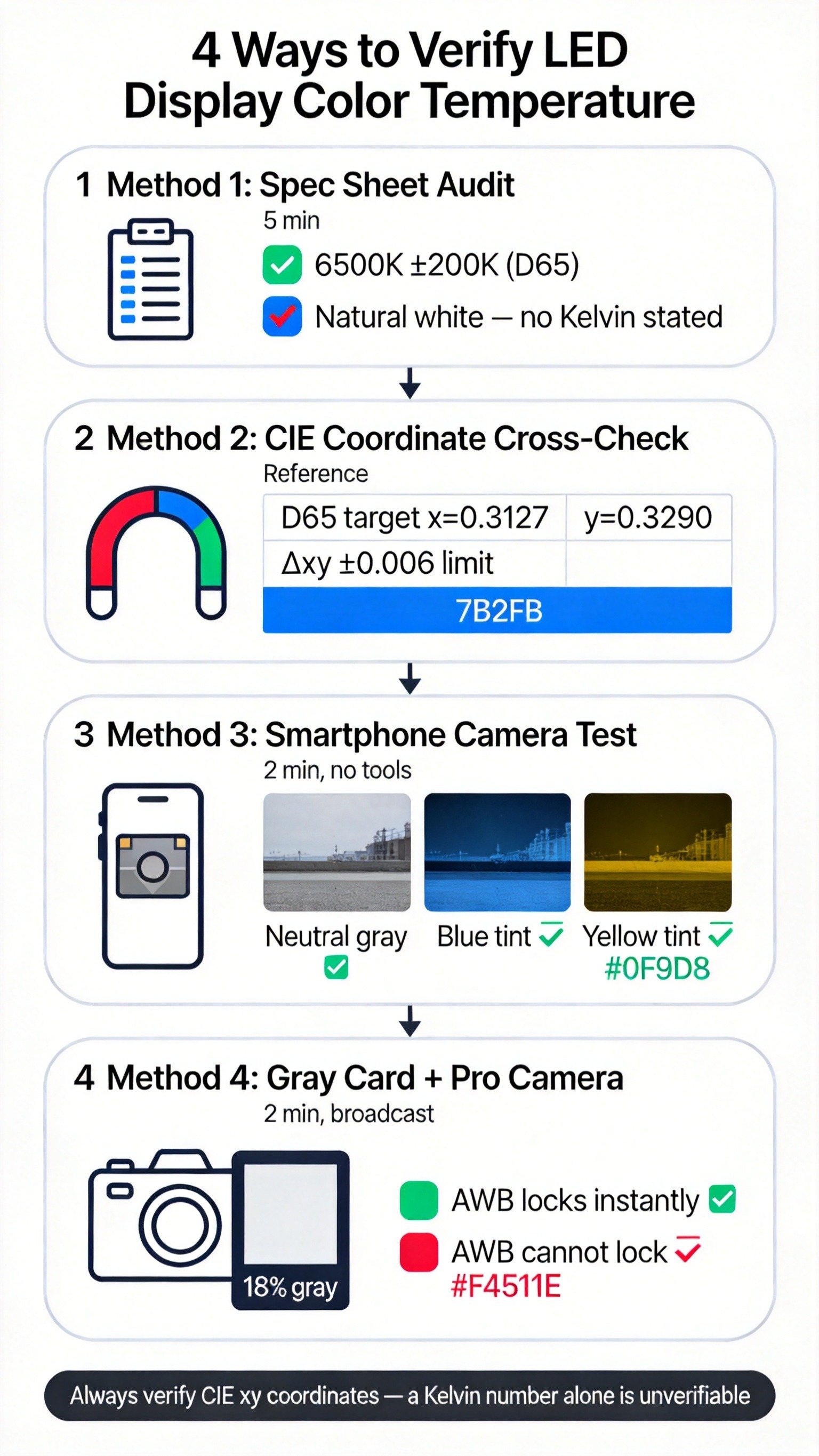
Use all four methods in sequence. Methods 1 and 3 require no specialist equipment. Method 2 provides irrefutable verification for high-stakes procurement.
Method 1 — Spec Sheet Audit (5 minutes) Evaluate supplier documentation before any site visit:
✅ Acceptable: Color temperature: 6500K ±200K (D65) · CCT: 9300K, CIE xy (0.285, 0.293) ? "Natural white" — no Kelvin value stated ? "Cool white" — describes appearance, not calibration ? "Standard white" — no international standard cited ? "Adjustable 3200K–9300K" — no factory calibration baseline confirmed
Any spec sheet that omits CIE xy coordinates cannot be verified against D65 or any international standard. Treat it as a reject document.
Method 2 — CIE Coordinate Cross-Check (Reference standard) Require measured CIE coordinates at rated drive current. A Δxy deviation above 0.006 represents a visible color error (ΔE ≥ 3) — the threshold at which inaccuracy becomes noticeable to an untrained eye. Reference values are included in the Camera Compatibility table above.
Method 3 — Smartphone Camera Test (2 minutes, zero equipment) Open your smartphone camera. Point it at a powered LED panel displaying a full-white image. Observe through the camera preview — not with the naked eye:
Neutral white / gray in preview → color temperature within normal range ✅ Yellow-orange tint → color temperature below 5,000K — warmer than specified ? Blue-purple tint → color temperature above 7,000K — verify against spec ? AWB hunts / flickers continuously → color temperature outside 3,200K–6,500K camera range — 9300K behavior confirmed ?
Method 4 — Gray Card + Professional Camera (2 minutes, broadcast only) Place an 18% neutral gray card in front of the powered display. Set the camera to Auto White Balance:
AWB locks instantly, card appears neutral → color temperature within camera range ✅ Residual blue or yellow cast after AWB lock → white balance drift present, ΔE measurable ? AWB cannot lock → color temperature outside usable broadcast range ?
3 Procurement Traps to Avoid
Trap 1 — "Higher color temperature = better quality" A 3200K LED display broadcast studio specification is non-negotiable when tungsten stage lighting is present — yet suppliers routinely default to 9300K and call it "high quality." 9300K is appropriate for exactly one context: large outdoor screens with no camera requirements and no close-range viewing. For every other application, 9300K introduces visible color accuracy problems that post-processing cannot fully correct. Evaluate color temperature against your installation context, not against a supplier's upsell.
Trap 2 — Skipping white balance verification Color temperature and white balance are inseparable. A panel shipped with a factory-set D65 (6500K) color temperature but drifted white balance may display visually as 5,500K or 7,000K. Always require CIE xy coordinates alongside the Kelvin value — without them, the Kelvin number is technically unverifiable and commercially unenforceable.
Trap 3 — No post-sale recalibration agreement LED channel aging shifts white balance within 12–24 months of continuous operation. A supplier who cannot state a per-module recalibration price transfers that maintenance risk entirely to you. Before signing, confirm three things: Does the supplier offer annual recalibration? What is the per-module cost? Is the first recalibration covered under warranty?
Frequently Asked Questions
Q: What is the best color temperature for LED displays? D65 (6500K) is the best color temperature for most LED display applications. It simultaneously satisfies the IEC 61966-2-1 display standard, ITU-R BT.709 broadcast standard, and natural daylight spectrum. Use 9300K only for large outdoor screens with no camera requirements. Use 3200K exclusively for broadcast studios with tungsten stage lighting.
Q: What is the D65 standard in LED display color temperature? D65 is the international white point defined by the CIE at x=0.3127, y=0.3290 — equivalent to approximately 6500K daylight. Importantly, not every 6500K LED display achieves true D65: the Duv (distance from the Planckian locus) of a generic 6500K panel can reach 0.0071, versus 0.0032 for a properly D65-calibrated panel — a visible difference under camera. Always request CIE coordinates, not just a Kelvin number.
Q: Why is 9300K not recommended for broadcast LED screens? 9300K exceeds the Auto White Balance upper limit of professional cameras (3200K–6500K), leaving a residual color error of ΔE 3–6 in recorded footage after correction. For broadcast studio LED displays, a 3200K specification matches tungsten stage lighting directly — eliminating color correction entirely and achieving ΔE < 2 between screen and ambient light.
Q: What is the difference between 6500K and 9300K LED screens? 6500K vs 9300K LED screens differ across three measurable dimensions: 9300K appears 10–15% brighter perceptually at identical nits; produces blue-tinted footage under professional cameras that AWB cannot fully correct; and its Blue channel degrades 15–20% faster over 50,000 operating hours — causing earlier color temperature drift than a balanced D65 (6500K) panel.
Q: How do I adjust LED display color temperature after installation? Most LED display controllers support color temperature adjustment within ±500K via RGB gain software controls — no hardware change required. For adjustments beyond ±500K, professional on-site recalibration using a colorimeter is required at approximately $0.30–0.80 per module. Schedule recalibration annually for continuous-operation installations such as control rooms and broadcast studios.
Q: How does color temperature affect LED screen eye comfort? Color temperatures above 7,000K increase short-wavelength blue light exposure, which raises photoreceptor stimulation and accelerates eye fatigue during extended close-range viewing — documented in ISO 9241-307. For control rooms, dispatch centers, and broadcast sets where operators view screens for 4+ consecutive hours at distances under 3m, specifying D65 (6500K) or lower measurably reduces eye strain complaints across shift work periods.