


 English


IP65 is mandatory for any LED display exposed to direct rain; IP54 is the correct — and cost-optimal — specification for indoor and covered installations. Choosing the wrong IP rating costs far more than the price gap. An outdoor LED display under-specified at IP40 accumulates $3,000–8,000 in repair costs within five years.
Over-specifying IP67 for an indoor boardroom wastes 20–30% of your budget on protection you will never use. This guide decodes both ratings using IEC 60529 test data, explains why your spec sheet shows two different IP numbers, and delivers a five-step selection framework — so you buy exactly the protection your installation requires, nothing more.
Quick Answer — IP54 vs IP65 at a Glance
| Specification | IP54 | IP65 |
|---|---|---|
| Dust Protection | Level 5 — limited ingress, no harmful deposit | Level 6 — fully dust-tight ✅ |
| Water Protection | Level 4 — splash from any direction | Level 5 — low-pressure jet, any direction |
| IEC 60529 Water Test | 12.5mm nozzle · 10 L/min · 3 min | 6.3mm nozzle · 12.5 L/min · 3 min |
| Typical Front Panel | ✅ COB indoor LED display (native) | ✅ Outdoor LED display (mandatory minimum) |
| Typical Rear Panel | IP30 (indoor fixed) | IP54 (outdoor) |
| SMD to Reach This Level | GOB coating required | GOB coating required |
| Flip Chip COB Native? | ✅ IP54 native — no extra process | ⚠️ Possible with cabinet-level sealing |
| Cost vs IP20 Baseline | +10–15% | +20–30% |
| Best Use Case | Indoor · Covered semi-outdoor · Cinema | Outdoor billboard · Street · High-dust |
? All IP ratings per IEC 60529 international standard. Always request full-unit certification — front panel, rear panel, and connectors tested and certified separately.
What IP Ratings Actually Mean: IEC Test Data
Every LED display IP rating contains two digits. Each answers one question: can dust get in, or can water get in. The IEC 60529 international standard defines exactly how each level is tested — and knowing those test conditions changes how you evaluate a spec sheet.
First Digit — Dust Protection (Levels 4–6)
The first digit measures resistance to solid particle ingress into the LED display cabinet. For procurement decisions, levels 4 through 6 are the only ones that matter:
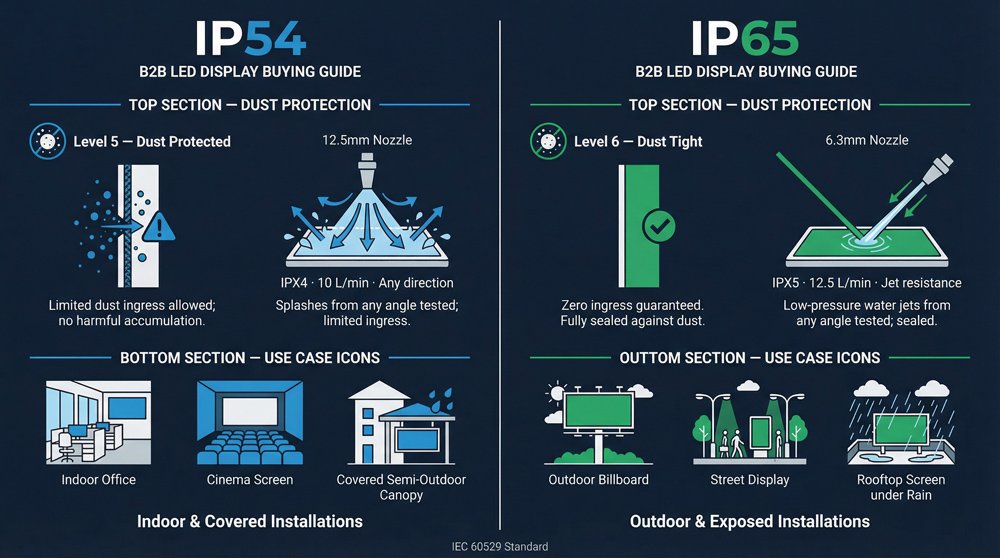
Level 4: Protects against solid objects larger than 1mm — adequate for clean, controlled indoor environments Level 5: Dust-protected — limited dust ingress permitted, but not enough to affect LED display operation or cause harmful deposits Level 6: Dust-tight — zero ingress under any conditions; mandatory for outdoor, industrial, or high-sand environments
The practical gap between Level 5 and Level 6 is larger than the single digit implies. Dust accumulation on internal LED display components reduces thermal dissipation, directly accelerating LED degradation. In a 10m² outdoor LED display running 12 hours daily, inadequate dust protection can reduce component lifespan by 15–25% within three years.
Second Digit — Water Protection + IEC 60529 Test Conditions
This is where LED display IP rating decisions go wrong most often. The difference between IPX4 and IPX5 is not one number — it is the difference between surviving a splash and surviving a direct water jet:
| Level | IEC 60529 Test Condition | What It Means in Practice |
|---|---|---|
| X3 | Simulated rainfall, up to 60° angle | Protected against angled rain |
| X4 | 12.5mm nozzle · 10 L/min · 3 min | Splash from any direction |
| X5 | 6.3mm nozzle · 12.5 L/min · 3 min | Low-pressure water jet, all directions |
| X6 | 12.5mm nozzle · 100 L/min · 3 min | High-pressure water jet |
| X7 | Immersion 1m depth · 30 min | Temporary submersion |
IPX5 delivers 25% higher water flow than IPX4 — but that number understates the real difference. IPX4 cannot withstand any directional water stream at any pressure. A standard garden hose held 1m from an IP54 LED display can cause water ingress; the same test against an IP65 display will not. For maintenance teams that clean LED displays with pressure-washing equipment, IP66 or higher is the correct minimum specification.
Why LED Display Specs Show Two IP Numbers
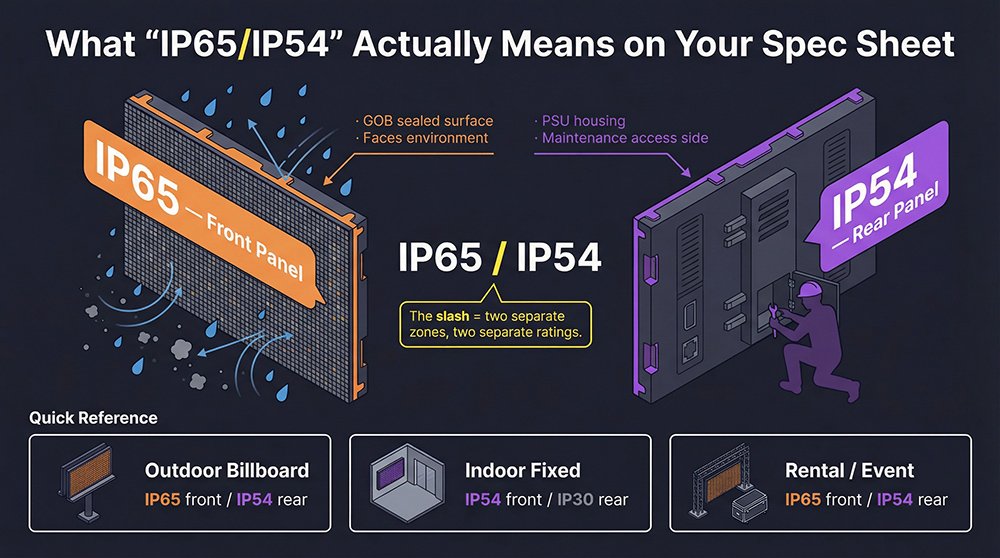
When a spec sheet reads "IP65/IP54," most buyers assume it is a typo. It is not. The slash separates two distinct IP ratings applied to two different physical zones of the same LED display — and confusing them is one of the most expensive mistakes in LED display procurement.
Front Panel IP — The Environmental Contact Zone
The front panel is the pixel-emitting face that directly contacts rain, dust, humidity, and cleaning agents. This zone always carries the higher IP rating:
Indoor Flip Chip COB LED displays (e.g., XVisual Ace series): IP54 front — achieved natively through sealed resin encapsulation, with no additional coating or treatment required Outdoor SMD LED displays: IP65 front — requires GOB — Glue-on-Board coating — to seal individual LED packages against water jet ingress
Rule of thumb: The front panel IP rating determines whether your LED display is compatible with its installation environment.
Rear Panel IP — The Maintenance Access Zone
The rear panel covers the PSU (power supply unit) housing, cable routing, and maintenance access. Because this surface typically faces a maintenance corridor or building interior, it carries a lower IP rating:
Indoor fixed LED display installations: IP30 rear is the industry standard — protects against solid objects larger than 2.5mm, no water protection required Outdoor LED display installations: IP54 rear is the minimum — protects against condensation, maintenance splash, and water migration from cable entries
| Installation Type | Front IP | Rear IP | Key Reason |
|---|---|---|---|
| Indoor COB LED display | IP54 | IP30 | Front exposed; rear in maintenance corridor |
| Indoor SMD LED display | IP20–IP40 | IP20 | Fully controlled environment |
| Semi-outdoor — covered | IP54 | IP30–IP54 | Humidity on front, limited rear risk |
| Outdoor billboard | IP65 | IP54 | Full weather exposure on both sides |
| Rental / touring event | IP65 | IP54 | Transport + outdoor event exposure |
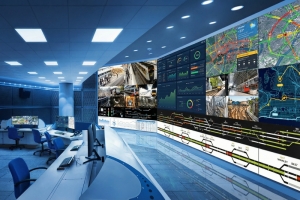
| Private cinema / command center | IP54 | IP20–IP30 | COB performance matters more than waterproofing |
⚠️ The procurement trap: Many manufacturers label an LED display "IP65" when only the front panel meets that standard. The rear panel and cable connectors may be IP54 or lower. For outdoor LED display installations, require your supplier to provide an IEC 60529 third-party test report that explicitly certifies front panel, rear panel, and all connectors independently — not a single blanket rating.
How Encapsulation Sets Your IP Rating Ceiling
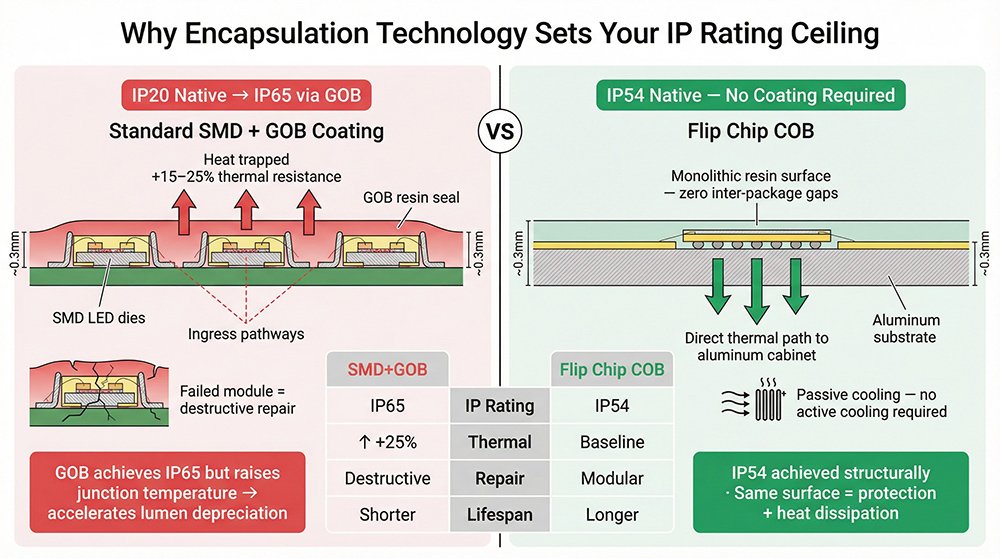
Your LED display IP rating is a physical ceiling — set by the encapsulation technology inside the panel, not a number you simply select from a specification form. Some LED displays cannot reach IP65 without a process that measurably compromises long-term performance.
Standard SMD — IP Ceiling: IP20 (IP65 Requires GOB)
In a standard SMD package, each LED die sits in an individual cup that protrudes above the PCB surface. The gaps between individual packages create continuous ingress pathways for dust and water — which is why bare SMD LED display panels carry a default IP rating of IP20.
Reaching IP65 requires GOB processing — Glue-on-Board, a technique where a transparent resin layer floods across the entire pixel surface, sealing all inter-package gaps. GOB achieves IP65, but at a measurable cost:
Thermal resistance increases 15–25% versus uncoated SMD, raising LED junction temperature under equivalent operating load Maintenance becomes destructive: a failed module behind GOB coating cannot be replaced without damaging adjacent pixels
The core trade-off: sealing the surface also seals in heat — and elevated junction temperature is the primary driver of LED lumen depreciation in any LED display.
Flip Chip COB — IP54 as a Native Structural Property
Flip Chip COB inverts the LED die entirely, bonding through metal bumps directly to the aluminum substrate rather than via gold wire bonds. The result is a continuous, flat, resin-sealed surface with no protruding components and no inter-package gaps.
IP54 is not applied to a Flip Chip COB LED display — it is an inherent consequence of the structure. The same sealed surface that delivers IP54 protection also creates a direct thermal path from chip to substrate, enabling passive aluminum cabinet dissipation to handle full operating load without active cooling. There is no trade-off between protection and thermal performance — making IP54 the performance-optimal IP rating for indoor LED display applications.
| Encapsulation | Native IP Rating | IP65 Achievable | Method | Key Trade-off |
|---|---|---|---|---|
| Standard SMD | IP20 | ✅ Yes | GOB coating | ↑ Thermal resistance · Hard to repair |
| Standard COB | IP40–IP50 | ✅ Yes | Extra resin sealing | Minor thermal impact |
| Flip Chip COB | IP54 | ⚠️ Possible | Cabinet-level gasket | Minimal trade-off |
| GOB-on-SMD | IP65 | ✅ Native | GOB process | Repair difficulty ↑↑ · Lifespan risk ↑ |
? Key insight: A Flip Chip COB LED display rated IP54 will typically outlast a GOB-coated SMD LED display rated IP65 — because IP65 was achieved by adding thermal resistance, while IP54 was achieved by removing failure points.
5 Steps to Select the Right IP Rating
The most common LED display IP rating mistake is treating it as a single specification rather than a matched pair. Use this five-step framework before finalizing your display specification.
Step 1 — Determine rain exposure (the primary decision gate) Will this LED display ever be directly rained on?
YES → IP65 front-panel IP rating on your LED display. No exceptions. NO → IP54 is likely sufficient. Continue to Step 2.
This one question eliminates the majority of LED display IP rating specification errors. "Semi-outdoor" is not a single category — a display under a 2m canopy in a monsoon climate may receive direct rain; a window-facing display behind glass never will.
Step 2 — Assess the dust environment High-dust environments — construction sites, desert-adjacent locations, industrial facilities — require IP6X dust-tight certification on your LED display. Standard urban outdoor and indoor environments are adequately served by IP5X.
Step 3 — Confirm what your encapsulation technology can natively achieve Specifying IP65 for an SMD LED display without confirming GOB treatment has been applied is a procurement error. Verify the encapsulation method and its certified IP rating level before accepting the specification.
Step 4 — Set front and rear panel IP ratings separately Use the matrix in Section 2. Do not accept a single IP number without clarifying which panel it applies to on your LED display.
Step 5 — Require IEC 60529 full-unit certification Request the third-party laboratory test report. Confirm it certifies front panel, rear panel, and cable connectors independently. If a supplier cannot provide this IEC 60529 document, treat the stated LED display IP rating as unverified.
| Environment | Front IP | Rear IP | Cost Premium vs IP20 |
|---|---|---|---|
| Outdoor — street, rooftop, billboard | IP65 | IP54 | +20–30% |
| Semi-outdoor — uncovered, rain possible | IP65 | IP54 | +20–30% |
| Semi-outdoor — covered, rain unlikely | IP54 | IP30 | +10–15% |
| Indoor standard — office, boardroom, retail | IP40–IP54 | IP20–IP30 | +0–15% |
| Indoor high-risk — factory, pool, food service | IP54–IP65 | IP54 | +15–25% |
| Rental / touring events | IP65 | IP54 | +20–30% |
| Private cinema / command center | IP54 | IP30 | +10–15% |
3 Rules to Avoid IP Rating Mistakes
LED display IP rating misrepresentation is not rare in this industry. These three rules give you verifiable checkpoints that require no specialist equipment.
Rule 1 — Require IEC 60529 Full-Unit Certification, Not a Product Label
The question to ask every LED display supplier: "Is this IP rating certified for the full unit — front panel, rear panel, and connectors — or front panel only?"
Reputable suppliers provide an IEC 60529 third-party laboratory report specifying each zone independently. If a supplier responds with a product brochure or an internal test certificate, treat the IP rating claim as unverified. For outdoor LED display installations, all three zones must independently meet IP65.
Rule 2 — Verify Sealing Quality On-Site Before Signing
Three checks that take under five minutes and require no tools:
Seal type: LED display module edges should have continuous elastomeric gaskets — not bead-applied silicone sealant, which degrades and develops gaps within 12–18 months outdoors Connector sealing: Each cable entry point should have an IP-rated connector with a compression seal, not an open gland Drainage provision: High-quality IP65 outdoor LED display cabinets include bottom drain holes — allowing any water that migrates past seals to exit rather than accumulate against PCBs
Rule 3 — Calculate 5-Year Total Cost of Ownership (TCO), Not Unit Price
| Procurement Decision | Upfront Delta | 5-Year Hidden Cost | Verdict |
|---|---|---|---|
| Outdoor LED display at IP40 | Save $500–1,500 | $3,000–8,000 repair + downtime | ❌ False saving |
| Indoor LED display over-specified to IP67 | +$800–2,000 | Zero additional protection value | ❌ Wasted budget |
| IP54 COB for indoor / covered LED display | Correct budget | Lowest TCO + longest lifespan | ✅ Optimal |
Frequently Asked Questions
Q: Is IP65 required for all outdoor LED displays? IP65 is the minimum IP rating for any LED display exposed to direct rain or dust — including street-facing, rooftop, and billboard installations. Covered semi-outdoor LED display environments where rain contact is unlikely can use IP54, but require periodic seal inspection to prevent gasket degradation over time.
Q: What does "IP65/IP54" mean on an LED display spec sheet? The slash format indicates two separate IP ratings: IP65 for the front panel (pixel face) and IP54 for the rear panel (PSU and maintenance side) of the LED display. Always verify both ratings independently via an IEC 60529 third-party test report — a single "IP65" label without a slash may cover the front panel only.
Q: Which LED encapsulation gives the best IP protection without reducing lifespan? Flip Chip COB achieves IP54 natively through its sealed resin structure — no GOB coating required. Standard SMD LED display panels require GOB to reach IP65, which increases thermal resistance by 15–25% and raises LED junction temperature, shortening operational lifespan. For indoor and semi-outdoor applications, Flip Chip COB at IP54 remains the cost and performance benchmark.
Q: How much more does IP65 cost compared to IP54 for LED displays? IP65 typically carries a 20–30% cost premium over IP54 at equivalent pixel pitch and panel size, driven by GOB processing, full-enclosure cabinet engineering, and connector upgrading. For indoor LED display applications, this premium delivers no measurable protection benefit — IP54 COB is the cost-optimal IP rating specification.
Q: Why does a GOB-coated SMD LED display sometimes fail faster than a non-GOB display? GOB coating seals the LED display pixel surface but simultaneously traps heat generated by individual LED packages. The resulting 15–25% increase in thermal resistance raises junction temperature under operating load, accelerating lumen depreciation and color shift. Flip Chip COB eliminates this trade-off entirely — the sealed surface and the thermal dissipation path are the same physical structure.
Q: What is the minimum IP rating for rental LED displays? IP65 front / IP54 rear is the industry standard for rental LED display panels. Rental displays face outdoor event environments, repeated transport loading, and variable weather conditions. Panels below IP65 on the front face risk water ingress during outdoor events and physical damage to exposed LED packages during handling and transport.
Quick Takeaway
The one-line rule:
For any outdoor LED display — direct rain exposure → IP65 (non-negotiable) For indoor or covered installations → IP54 is the right IP rating
Before you approve the purchase order:
✅ Request IEC 60529 full-unit certification — front panel, rear panel, and connectors certified separately
✅ For outdoor LED displays: confirm IP65 front / IP54 rear — not a single blanket rating
✅ Verify elastomeric gasket seals on-site — not bead silicone, which develops gaps within 18 months
✅ For SMD LED displays targeting IP65: confirm GOB treatment is applied and documented
✅ Calculate 5-year TCO, not unit price — the wrong IP rating costs 3–5× the premium you saved