
 English


A 170° LED display viewing angle covers twice the audience width of a 160° spec at the same viewing distance — but in 80% of real installations, both numbers exceed the room's actual seating spread.
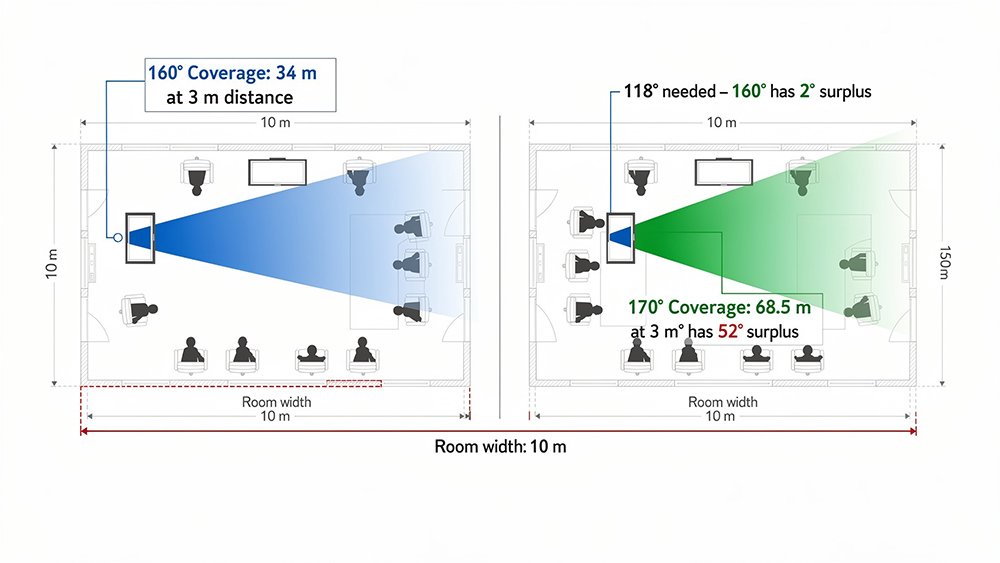
At a 3-metre viewing distance, 170° covers 68.5 metres of width versus 34 metres for 160°; yet a standard 10-metre-wide conference room at a 3-metre viewing distance only needs 118° minimum. The 15–20% price premium for 170° is justified in specific scenarios — and wasted in most others.
This guide covers three things: the geometry formula, SMD vs COB real-world impact, and a scene-by-scene spec table. You will have your answer in under two minutes.
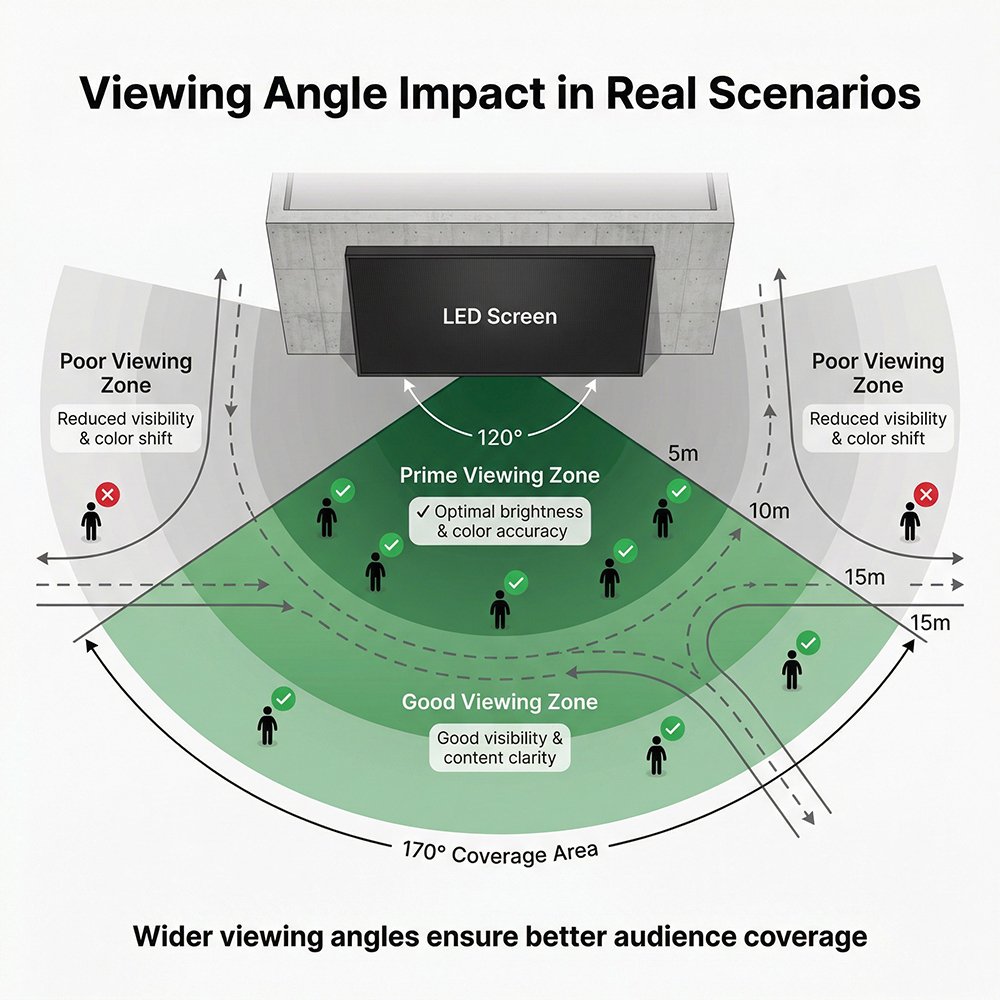
170° vs 160° LED Display Viewing Angle: Quick Comparison
| Spec Dimension | 160° Viewing Angle | 170° Viewing Angle |
|---|---|---|
| Half-angle | ±80° from centre | ±85° from centre |
| Coverage @ 3 m | ~34 m width | ~68.5 m width |
| Coverage @ 10 m | ~113 m width | ~228 m width |
| Edge brightness | 50% of centre ★★★☆☆ | 50% of centre ★★★★☆ |
| Color shift | Visible at ±70° (SMD) | Stable to ±80° (COB) |
| Typical package | Standard SMD / COB | Premium COB / custom-lens SMD |
| Price premium | Baseline | +15–20% over 160° |
| Best use case | Meeting rooms / outdoor ads | Stages / museums / broadcast |
⚠️ Measurement note: All angles above reference the 50%-brightness (half-brightness) industry standard. If a supplier quotes 170° using the 10:1 contrast ratio standard, actual half-brightness performance is likely 155°–160°. Always confirm the measurement basis before comparing vendor quotes.
What LED Display Viewing Angle Actually Means — The Formula Explained
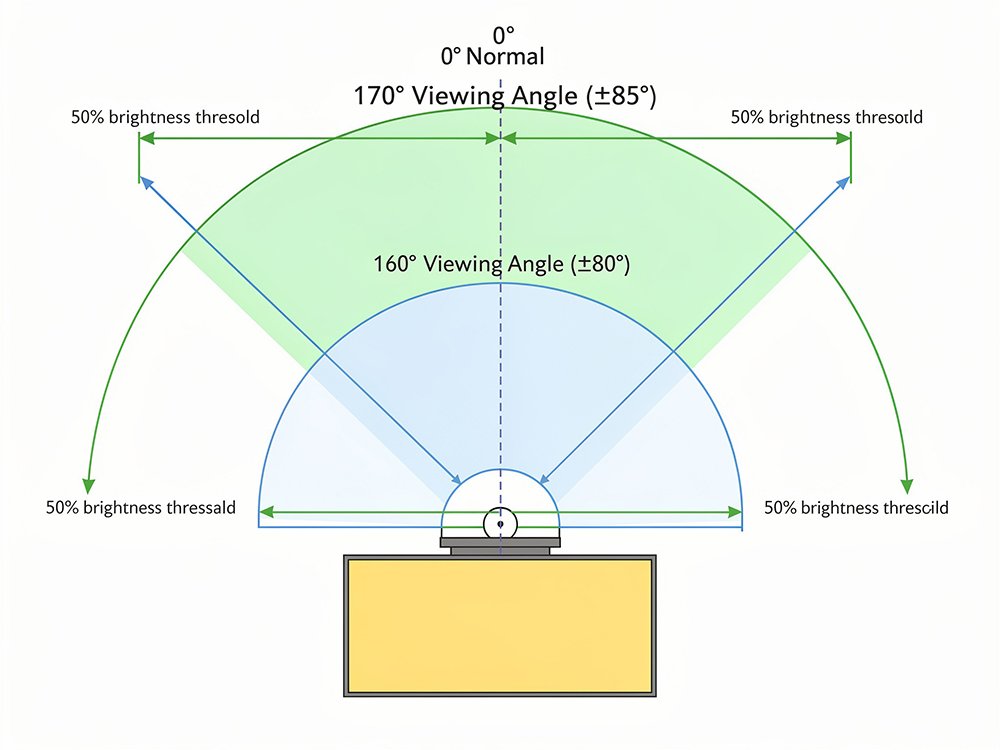
The LED display viewing angle on a data sheet marks the half-brightness boundary — not the point where the image goes dark, but the angle at which luminance has already dropped to 50% of the on-axis value. Understanding this definition prevents every major LED display viewing angle procurement mistake.
The Half-Brightness Definition
Picture the LED panel at full brightness when viewed head-on. Walk sideways until the image appears as if viewed through sunglasses — that is the viewing angle boundary, also called the half-angle point. At 160°, you reach that threshold at ±80° from the centreline. At 170°, the boundary sits at ±85°.
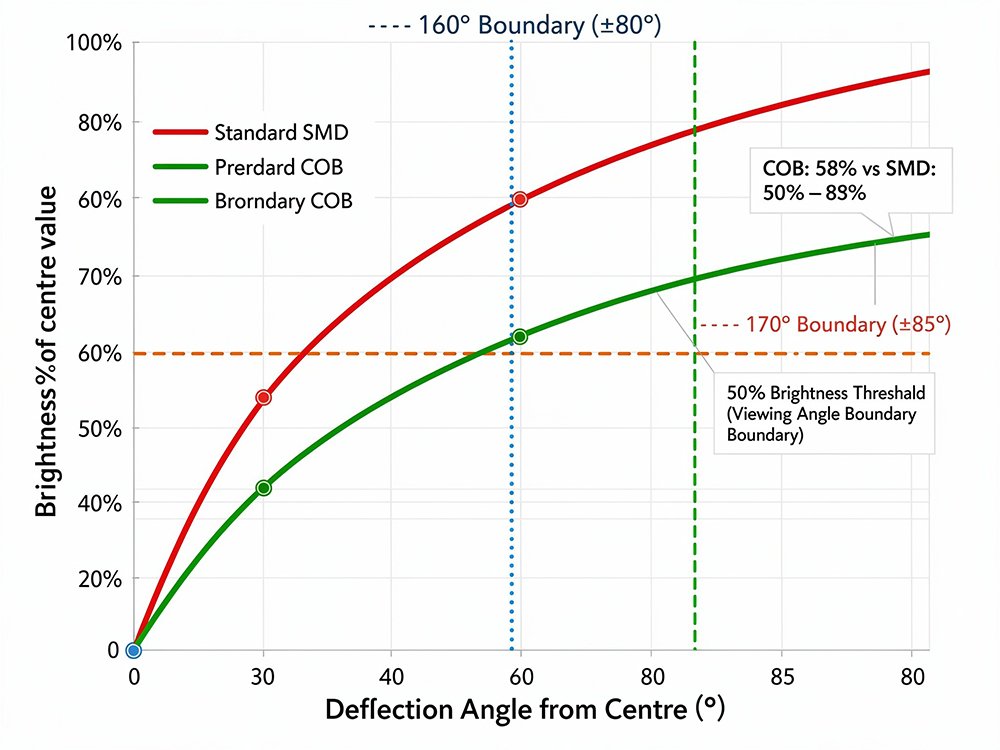
Brightness does not drop in a straight line as you move off-axis. The attenuation curve matters far more than the headline number:
| Deflection Angle | Standard SMD Brightness | Premium COB Brightness |
|---|---|---|
| 0° (centre) | 100% | 100% |
| ±30° | ~90% | ~95% |
| ±60° | ~70% | ~78% |
| ±80° (160° boundary) | 50% — 500 cd/m² at 1,000 nit* | ~58% — 580 cd/m² |
| ±85° (170° boundary) | ~42% | 50% — 500 cd/m² |
cd/m² = candela per square metre, the standard luminance unit used across all LED display specifications.
Key takeaway: At the 160° boundary, premium COB retains 58% brightness versus the 50% a standard SMD delivers. A 160° COB LED panel can therefore outperform a 170° SMD LED panel at identical oblique positions — the degree number alone does not tell this story.
The Coverage Width Formula
The geometry behind LED display viewing angle is straightforward:
Coverage Width = 2 × Viewing Distance (D) × tan(θ ÷ 2)| Viewing Distance | 160° Coverage Width | 170° Coverage Width | Difference |
|---|---|---|---|
| 3 m | 34.0 m | 68.5 m | +34.5 m (2×) |
| 5 m | 56.7 m | 114.3 m | +57.6 m (2×) |
| 10 m | 113.4 m | 228.5 m | +115.1 m (2×) |
The counterintuitive result: both specs already cover far more width than any standard room or outdoor installation requires. A 10-metre-wide conference room at 5-metre viewing distance needs only 90° minimum — 160° exceeds that by 70°, and 170° by 80°. In this scenario, the 15–20% price premium for the wider LED display viewing angle delivers zero practical benefit.
SMD vs COB: Package Type and Viewing Angle Performance
Two LED panels with identical 160° spec sheets can produce measurably different edge-viewing results — because the package architecture determines how brightness and color shift behave across the full angle range, not just at the rated boundary. This is the most under-discussed factor when evaluating any LED display viewing angle claim.
Why Package Architecture Changes the Angle Curve
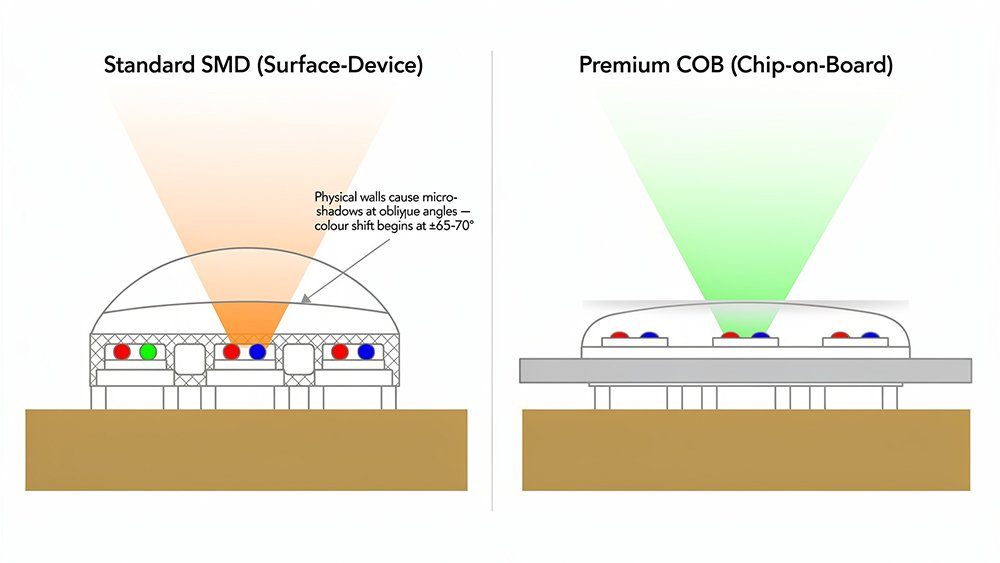
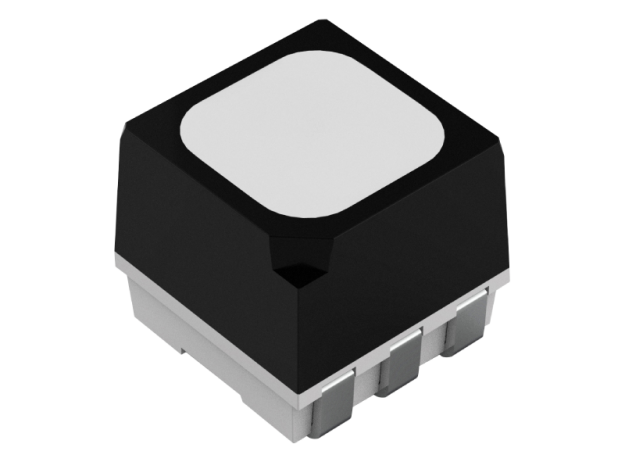
Standard SMD (Surface-Mounted Device) mounts R/G/B chips inside a plastic housing with physical walls between them. Those walls cast micro-shadows at oblique angles, accelerating color shift before you reach the rated boundary. COB (Chip-on-Board) bonds chips directly to the substrate without housing walls, producing a flatter, more uniform emission curve across the full ±80°–85° range.
| Package Type | Rated Viewing Angle | Color Shift Onset | Reflectance | Price Tier |
|---|---|---|---|---|
| DIP | 80°–120° | ±40° | High | Budget outdoor |
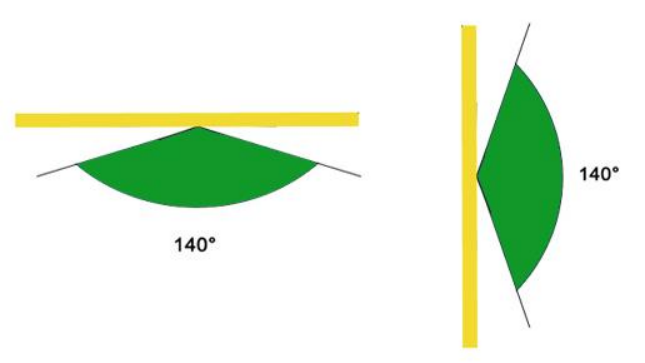
| Standard SMD | 140°–160° | ±65–70° | Medium | Mid commercial |
| Custom-lens SMD | 160°–170° | ±75° | Medium-low | Upper commercial |
| Standard COB | 160°–170° | ±78° | Low | Premium indoor |
| Premium COB | 170°+ | ±82° | Very low | Broadcast / museum |
DIP (Dual In-line Package): a legacy format used exclusively in budget outdoor screens. Not relevant for indoor or premium commercial procurement.
The Red Flag on the Data Sheet
If a supplier quotes 170° on a standard SMD LED panel, use this two-question test before proceeding:
"Is that LED display viewing angle measured at 50% brightness reduction or 10:1 contrast ratio?" "Can you confirm the package type in writing on the purchase order?"
A legitimate 170° SMD panel uses a custom-designed convex lens that widens the emission cone — reputable manufacturers confirm this without hesitation. Vague answers to either question are a reliable indicator of spec inflation.
When 160° COB beats 170° SMD: At ±75°, a premium COB LED panel rated at 160° retains ~65% of centre brightness with negligible color shift (ΔE < 3). ΔE measures perceptible color deviation — values below 3 are invisible to the human eye, while values above 6 are clearly visible to untrained observers. A standard SMD LED panel rated at 170° at the same ±75° angle may show ΔE > 6 and only 55% brightness — a visibly worse result despite the higher headline number. Specify package type on every RFP (Request for Proposal) alongside degree count.
Choosing the Right LED Display Viewing Angle for Your Application
Before selecting between 160° and 170°, reverse-calculate the minimum LED display viewing angle your installation actually requires — in most cases this formula eliminates the upgrade cost before you request a single quote.
Min. Required Angle = 2 × arctan(Audience Width ÷ 2 ÷ Viewing Distance)| Application | Audience Width | Viewing Distance | Min. Angle Needed | Verdict |
|---|---|---|---|---|
| Small meeting room | 6 m | 3 m | 90.0° | 160° — 70° surplus ✓ |
| Corporate boardroom | 10 m | 4 m | 102.7° | 160° — 57° surplus ✓ |
| Retail flagship store | 15 m | 5 m | 112.6° | 160° — 47° surplus ✓ |
| Large conference hall | 20 m | 8 m | 102.7° | 160° — 57° surplus ✓ |
| Stage / rental event | 30 m | 6 m | 136.4° | 160° — 23.6° surplus; 170° for color uniformity ✓ |
| Museum exhibition | 10 m | 3 m | 118.1° | 160° — 41.9° surplus; 170° for color fidelity ✓ |
| Broadcast studio | 12 m | 4 m | 112.6° | 160° — 47° surplus; 170° for camera accuracy ✓ |
The geometry formula confirms 160° exceeds the angular requirement in every scenario above — including stages and broadcast studios. The case for 170° rests entirely on color fidelity and camera performance, not coverage width.
For stage configurations where the audience arc exceeds 150°, a curved multi-panel array — rather than a single flat screen — is the recommended engineering approach regardless of rated viewing angle.
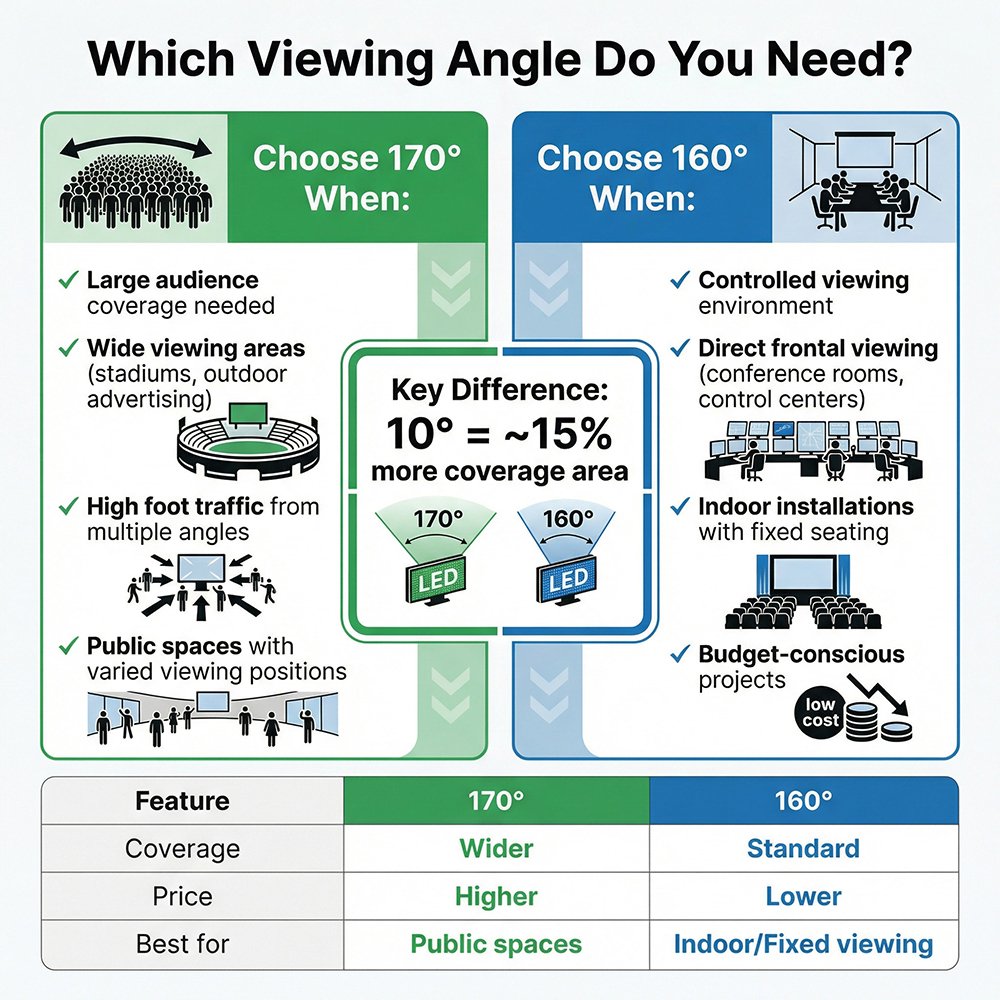
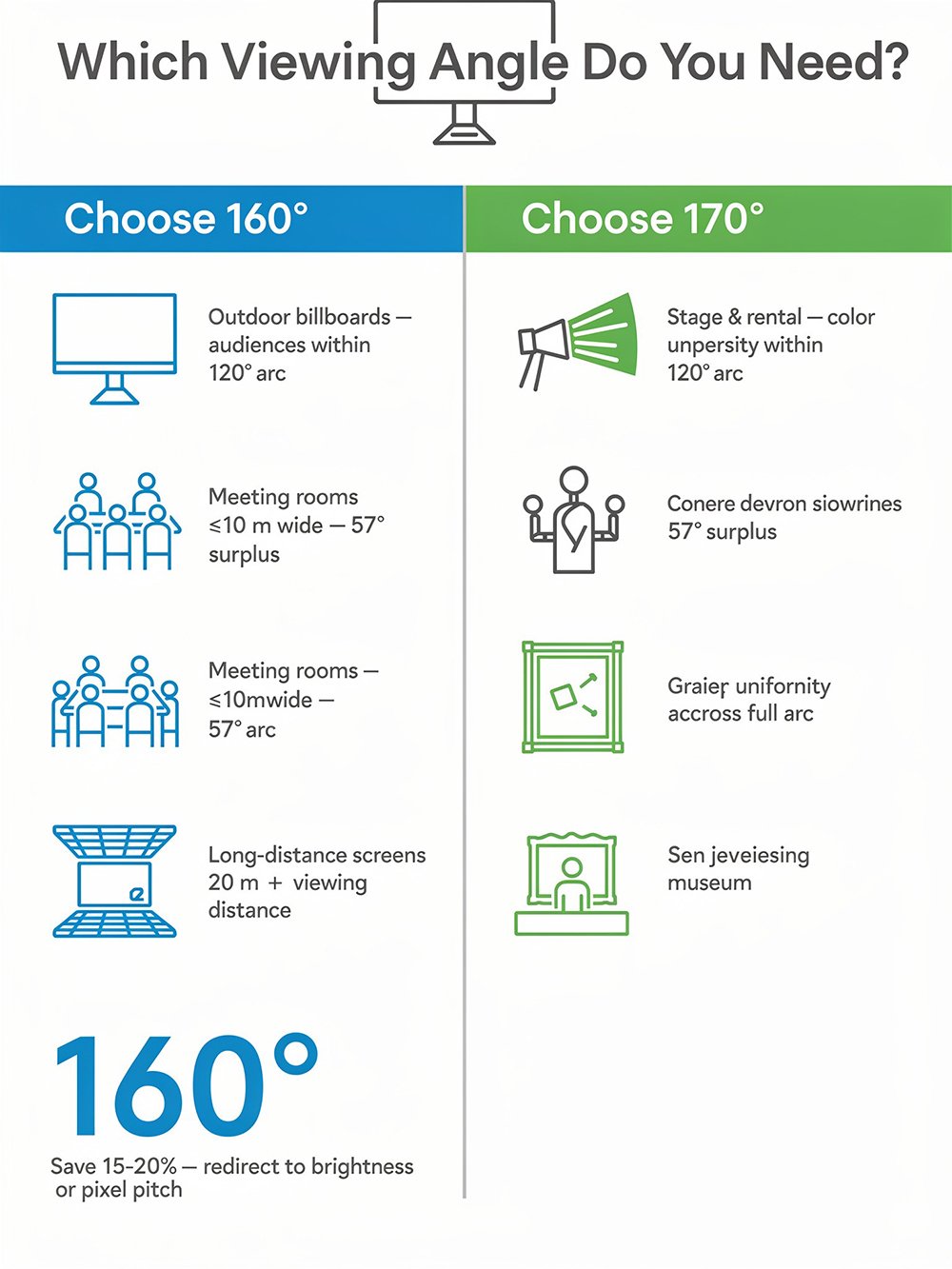
Choose 170° when:
Stage and rental installs — a 30m-wide stage at 6m depth produces a 136.4° audience arc, within 160° spec geometrically; however, color uniformity across that full arc demands the flatter attenuation curve of premium COB at 170° Color-critical near-viewing — jewellery showcases, museum displays, and broadcast studios demand ΔE < 3 at ±75°; only premium COB at 170° reliably meets this threshold Camera-on-site setups — cameras pointing at the LED panel from oblique angles capture brightness falloff just as the human eye does; 170° COB reduces hot-spot and washout artefacts in footage
Choose 160° when:
Outdoor billboards — roadside and building-facade audiences flow in a single direction rarely exceeding a 120° arc; invest the price difference in brightness (≥ 5,000 nit) instead Meeting rooms and conference halls — the formula confirms even a 20m-wide hall at 8m viewing distance needs only 102.7°; 160° provides a 57° surplus with no perceptible edge degradation Long-distance stadium screens — at 20+ metres viewing distance, the difference between the two LED display viewing angle specs produces less than 2° of perceptible divergence at any occupied seat
RFP Decision Rule:
Geometry alone never justifies 170° in standard installations — the formula confirms 160° covers every scenario above with 23–70° surplus. Color fidelity is mission-critical (ΔE < 3 at ±75°) → specify 170° COB. Camera pointed at screen from oblique angle → specify 170° COB. Neither condition applies → specify 160°, redirect 15–20% cost saving to brightness or pixel pitch.
How to Verify LED Display Viewing Angle On-Site
Never accept an LED display viewing angle claim from a data sheet alone — three field tests in under 10 minutes will confirm or contradict any spec without instruments.
Test 1 — The Color Walk Test (5 minutes)
Display a split screen: pure white (255, 255, 255) on the left, saturated red (255, 0, 0) on the right. Walk from the centreline sideways, pausing every 10°.
The angle at which red visibly shifts toward orange or yellow is your real color-shift boundary:
Genuine 160° LED panel: visible shift should not occur before ±75° Shift occurring at ±60° = confirmed spec inflation against the rated LED display viewing angle
Test 2 — Shadow Detail Test (3 minutes)
Set the display to a dark greyscale gradient (0–20% brightness). Stand at ±75° and verify that the 5% and 10% grey bands remain distinguishable. Premium COB panels maintain separation; standard SMD panels merge those bands, confirming accelerated brightness roll-off below the rated angle.
Test 3 — Written Documentation Checklist
Request these four items in writing before final sign-off:
☐ Viewing angle ≥ [160° / 170°] measured at 50% brightness reduction(half-brightness standard — not 10:1 contrast ratio)☐ Package type confirmed: [Standard COB / Premium COB / Custom-Lens SMD]☐ Horizontal and vertical viewing angles stated separately on data sheet☐ Color shift ΔE < 5 at the rated half-angle boundary
Any supplier unwilling to confirm measurement standard and package type in writing is a procurement risk — regardless of the headline degree number on their brochure.
LED Display Viewing Angle: FAQ
Q1: What is LED display viewing angle? LED display viewing angle is the maximum off-axis angle at which brightness remains at least 50% of the straight-on centre value — also called the half-brightness angle. A 160° LED panel maintains acceptable brightness up to ±80° from centre; beyond that, the image visibly dims and color shift becomes apparent.
Q2: What is a good viewing angle for an LED screen? For most commercial installations, 160° is a good viewing angle for an LED screen. It covers a 34-metre audience width at 3 metres viewing distance, exceeding the seating spread of virtually every standard room. Choose 170° only when color fidelity at oblique angles is mission-critical, or when cameras will be pointed at the screen from the side.
Q3: What is the real difference between 170° and 160° LED displays? The 10° gap doubles geometric coverage width (68.5 m vs 34 m at 3 m distance) — but geometry alone never requires 170° in standard installations, as even the widest stage configurations only need 136°. The meaningful difference is package quality: a 160° premium COB LED panel typically outperforms a 170° standard SMD panel in real edge-viewing color accuracy (ΔE < 3 vs ΔE > 6 at ±75°).
Q4: Why does my LED display look washed out at the sides? Viewing angle brightness loss accelerates near the rated boundary. Standard SMD LED panels reach visible color shift (ΔE > 5) at ±65–70°, well before the 80° boundary on the data sheet. Upgrading to COB — not just a higher LED display viewing angle rating — resolves this: premium COB maintains ΔE < 3 past ±78°.
Q5: How do I measure LED display viewing angle on site? Display a pure red image and walk sideways from the centre. Note the angle at which red shifts to orange — that is your real color-shift boundary. For a legitimate 160° LED panel, visible shift should not occur before ±75°. No instruments required; the full test takes under five minutes.
Q6: Which is better for outdoor LED displays — 160° or 170°? 160° is almost always the better choice for outdoor LED displays. Roadside and building-facade audiences rarely exceed a 120° arc, so 160° already provides a 40° surplus. Redirect the 15–20% cost difference to higher brightness (≥ 5,000 nit) and an IP65+ weather-resistance rating — both deliver measurable ROI that a wider viewing angle does not in outdoor contexts.
Understanding your LED display viewing angle — what the degree number means in geometry, how package type shapes real-world color performance, and when the 170° premium is genuinely justified — is the difference between a confident procurement decision and a costly specification mistake. Use the reverse-calculation formula, verify on-site with the three-test checklist, and confirm package type on every purchase order.