





 English


A 1000:1 contrast ratio means the display's peak white luminance is exactly 1,000 times brighter than its deepest black — measured at 10 lux ambient light, it is the commercial-grade baseline for LED displays. Yet a supplier quoting 100,000:1 dynamic contrast is not offering a better screen: in most cases, their static contrast sits below 800:1, which performs worse than an honest 1000:1 spec.
This guide decodes the formula and separates static from dynamic from ambient contrast. It shows which ratio each application actually requires, and delivers a 3-step on-site test to confirm the number before you sign off.
Contrast Ratio at a Glance
| Dimension | Static Contrast | Dynamic Contrast | Ambient Contrast |
|---|---|---|---|
| Definition | Same-frame white:black ratio, hardware only | Cross-frame ratio, algorithm-adjusted | Real-world ratio under actual lighting |
| Typical Range | 1,000:1 – 1,000,000:1 | 50,000:1 – 1,000,000:1+ | Far below static spec |
| Reliability | ★★★★★ Only reliable spec | ★★☆☆☆ Marketing figure | ★★★★★ Actual viewer experience |
| Affected By | LED bead quality, black mask, COB vs SMD | Brightness algorithm, software | Ambient lux, surface reflectance |
| Supplier Red Flag | Spec not stated by type | Any figure above 20,000:1 | Never mentioned on datasheet |
| Procurement Rule | Always demand in writing | Do not use as primary spec | Test on site under target lighting |
What 1000:1 Contrast Ratio Actually Means
Understanding contrast ratio in LED displays starts with one equation — and ends with knowing which of three very different specs your supplier is actually quoting.
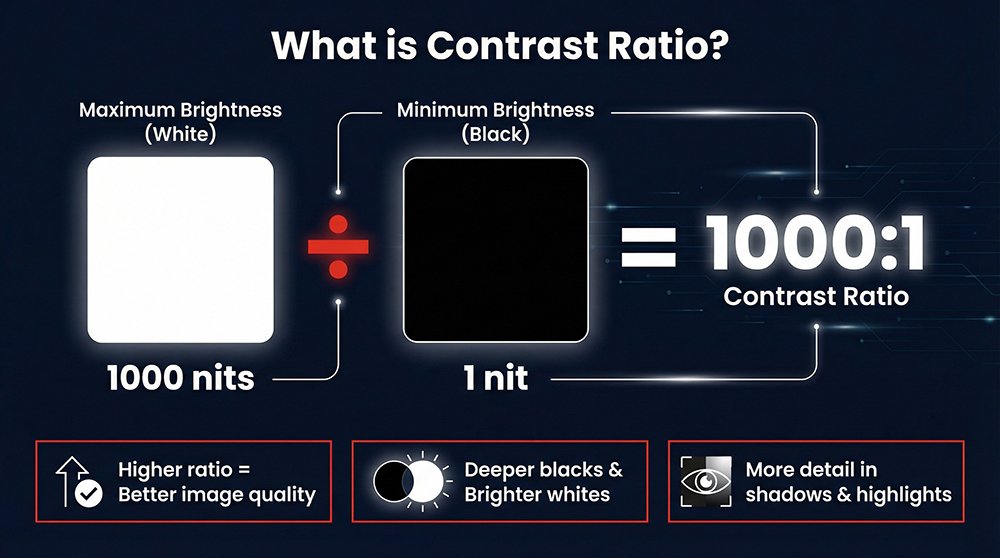
Contrast ratio follows one formula: Contrast Ratio = Peak White Luminance ÷ Minimum Black Luminance. A 1000:1 display producing 1,000 nit at peak white holds its black level at 1 nit. A 500 nit panel at the same ratio holds black at 0.5 nit. The ratio defines the gap — and the gap defines whether a dark scene looks deep and detailed or flat and grey.
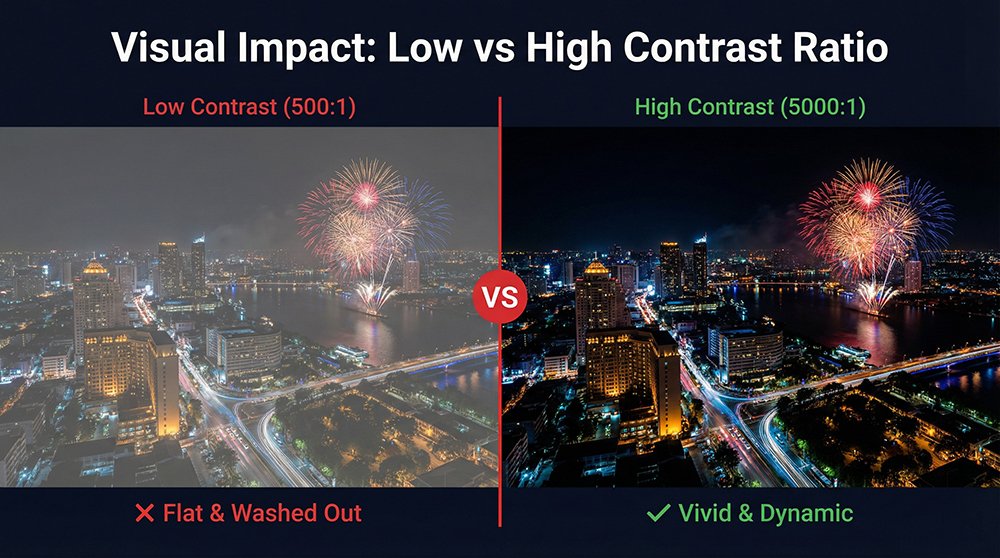
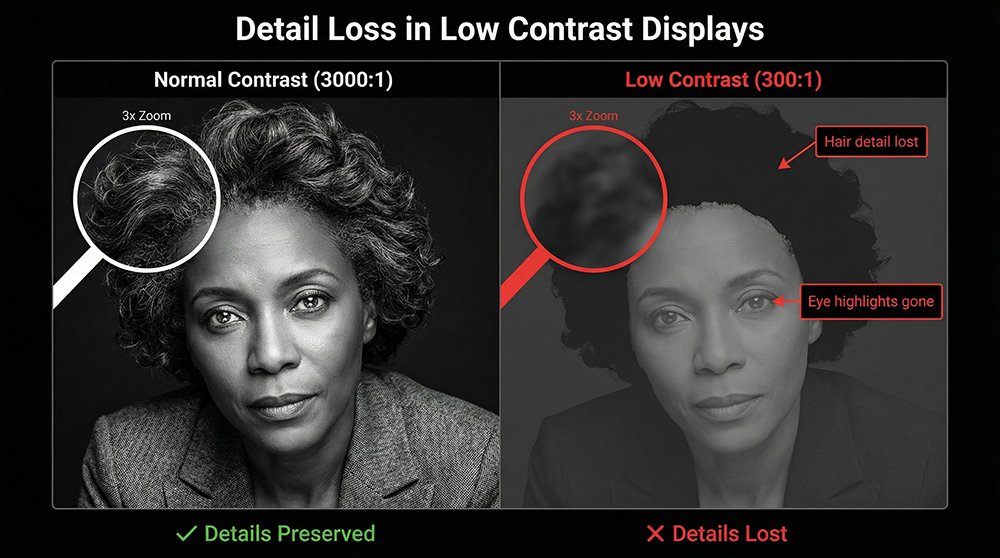
Think of a black-and-white photograph. On a high-contrast display, the whites are crisp and the blacks are deep enough to show shadow texture — fabric weave, hair strands, gradient transitions.
On a low-contrast display, the same image looks as though someone draped a grey filter over the entire scene. Whites appear dull, blacks appear washed out — and every detail in the shadow range disappears into a uniform grey mass.
Where 1000:1 sits in the industry:
| Contrast Ratio | Grade | Typical Application |
|---|---|---|
| 500:1 – 800:1 | Below commercial grade | Basic text signage |
| 1,000:1 | Commercial baseline | General indoor / outdoor |
| 2,000:1 – 5,000:1 | Premium grade | Retail, conference, museum |
| 8,000:1 – 20,000:1 | Broadcast grade | Studio, live events, broadcast |
| 1,000,000:1+ | Cinema / VP grade | Virtual production, ICVFX |
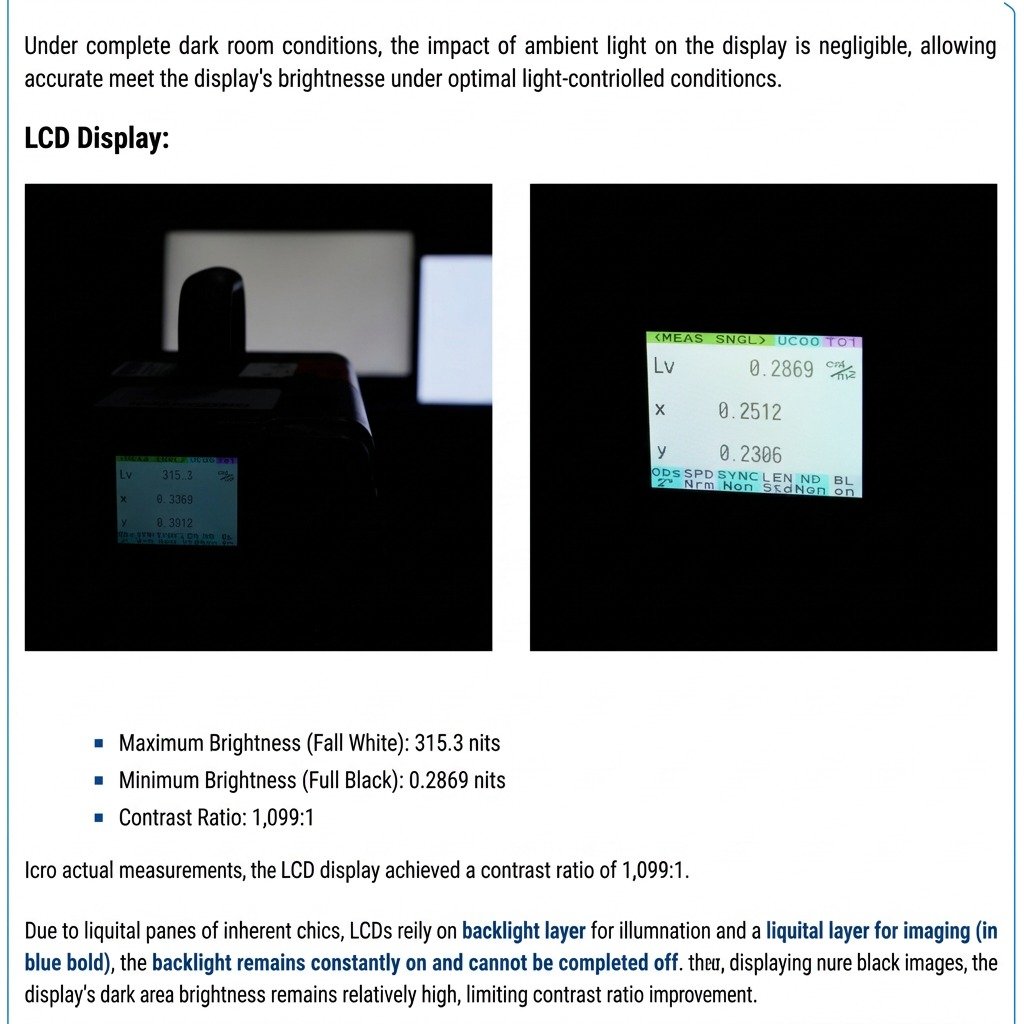
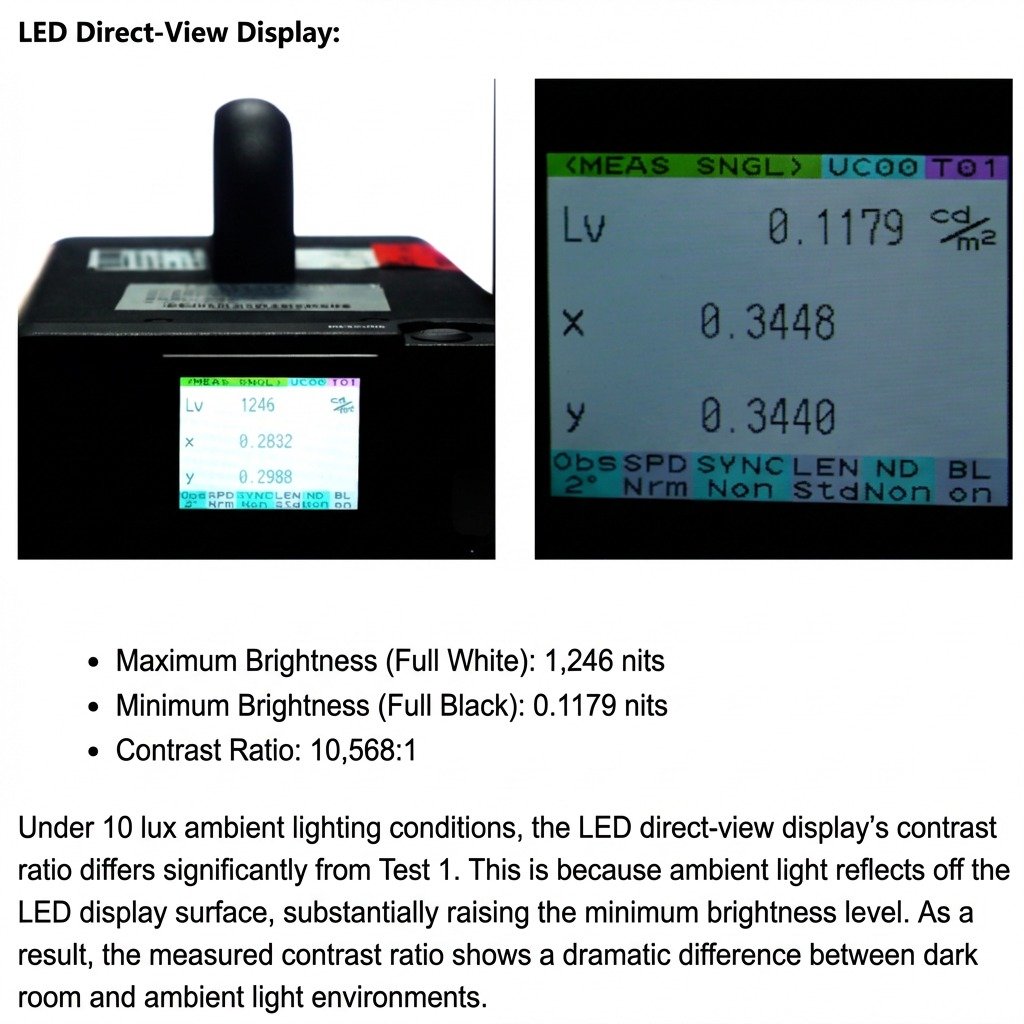
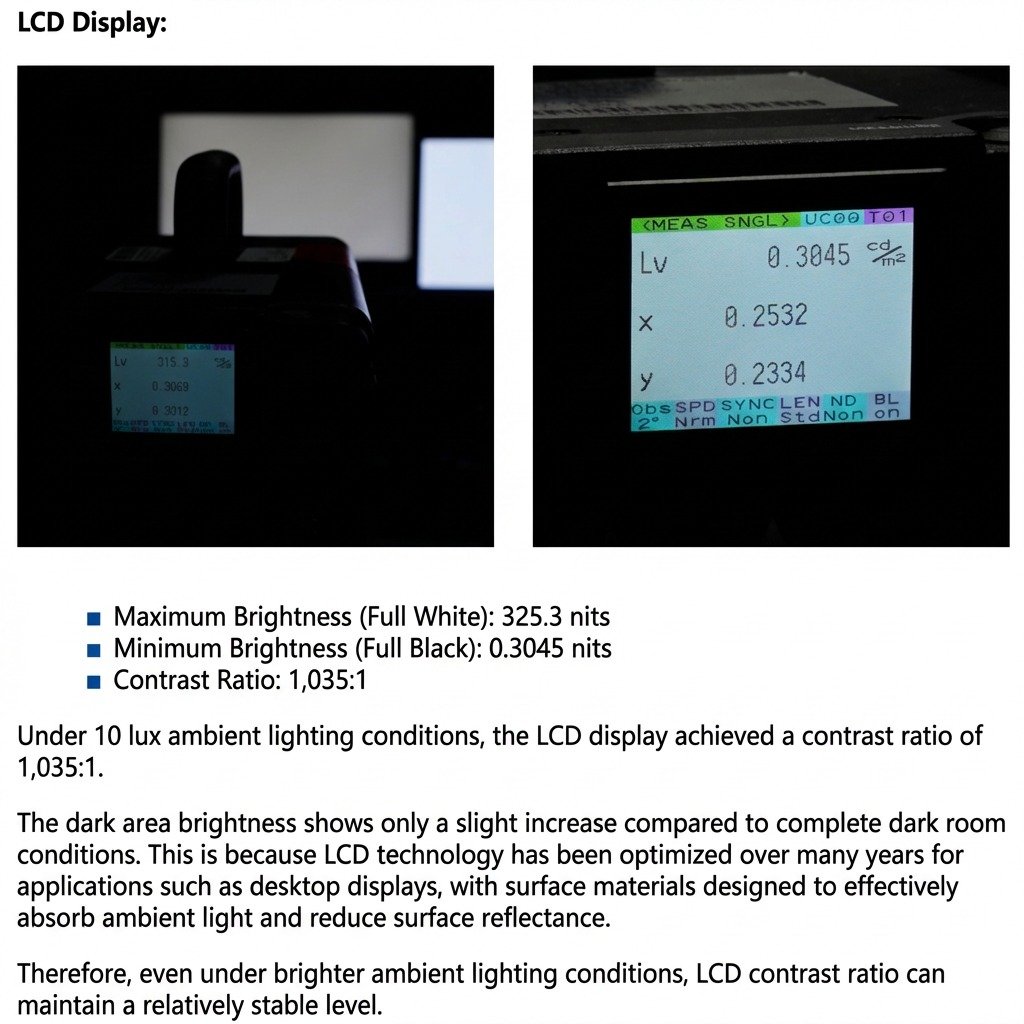
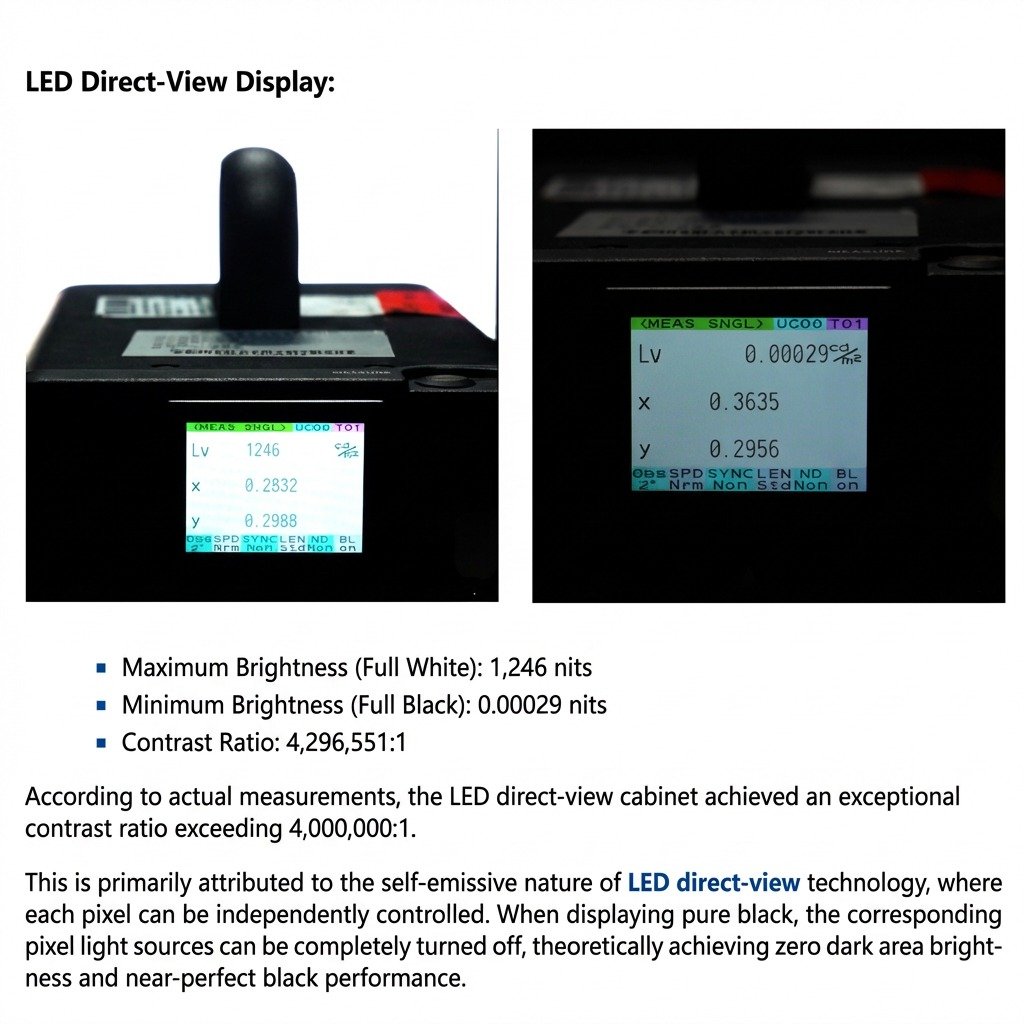
⚠️ Measurement standard alert: Industry standard SJ/T 11281-2007 specifies contrast ratio must be measured at 10 lux ambient light — not a darkroom. Suppliers testing at 0 lux can inflate figures by 3–5×. Always ask: "At what ambient light level was this contrast ratio measured?"
Static vs Dynamic vs Ambient Contrast
When comparing static vs dynamic contrast ratio in LED displays, the difference is not about magnitude — it is about what is actually being measured. Static contrast is the only figure that reflects real hardware performance. Dynamic and ambient contrast measure entirely different things, and confusing the three is the most expensive mistake in LED display procurement.
The Three Types Decoded
Static contrast measures the luminance ratio between pure white and pure black displayed simultaneously within a single frame, using only the panel's hardware output — no algorithm intervention. This is the spec that determines what you actually see on screen. Common values range from 1,000:1 to 5,000:1 for commercial LED; COB-packaged panels reach higher figures by reducing surface reflection between pixels.
Dynamic contrast measures the ratio between the brightest frame and the darkest frame across different content. It achieves its extreme numbers (50,000:1 to 1,000,000:1+) by dimming the entire screen during dark scenes and boosting it during bright scenes. The result is a visually unstable image: dark scenes become too dark to read, bright scenes become eye-straining, and the display appears to "breathe" as content changes. Dynamic contrast is a software behaviour, not a hardware capability.
The critical procurement insight: a display rated 100,000:1 dynamic contrast with an underlying static contrast of 800:1 will deliver worse real-world image quality than a display honestly rated 1,000:1 static contrast. The dynamic figure measures something entirely different — it is a marketing number generated by a different test.
Three Questions to Ask Any Supplier
Question 1: "Is this static or dynamic contrast ratio?" Any supplier who cannot answer immediately is quoting dynamic. A credible supplier states the type unprompted. Question 2: "What test method was used — Full On/Full Off, or ANSI checkerboard?" Full On/Full Off inflates figures by 3–10× compared to the ANSI checkerboard method. The ANSI method measures contrast across 16 alternating black and white rectangles in a single test image — it is the more demanding and more accurate standard. Question 3: "Can you provide the static contrast test report with measurement conditions?" A credible supplier will provide one. Others will redirect the conversation to dynamic figures or brightness specifications.
Ambient Contrast: What You Actually See
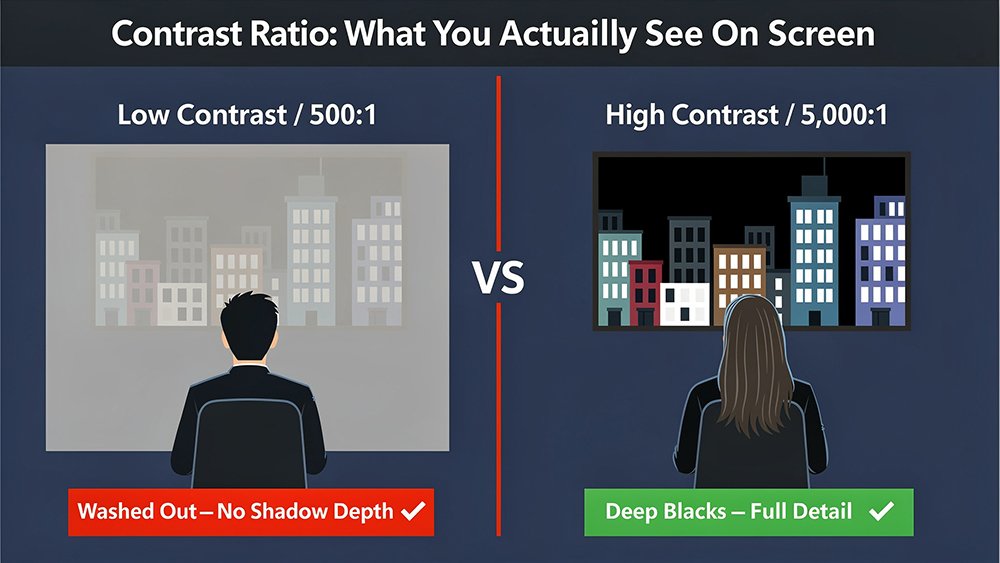
Ambient contrast is the contrast ratio you actually see — and in most real-world installations, it is 60–90% lower than the static figure on the spec sheet.
The Ambient Contrast Formula
Every installation adds ambient light on top of the display's own output. The formula that governs what your eye perceives is: ACR = (L_white + L_ambient) ÷ (L_black + L_ambient)
As ambient light increases, it contributes equally to both the bright and dark areas of the image. Because dark areas have almost no native luminance, ambient light proportionally destroys black depth far more than it affects whites. The result: contrast collapses in bright environments.
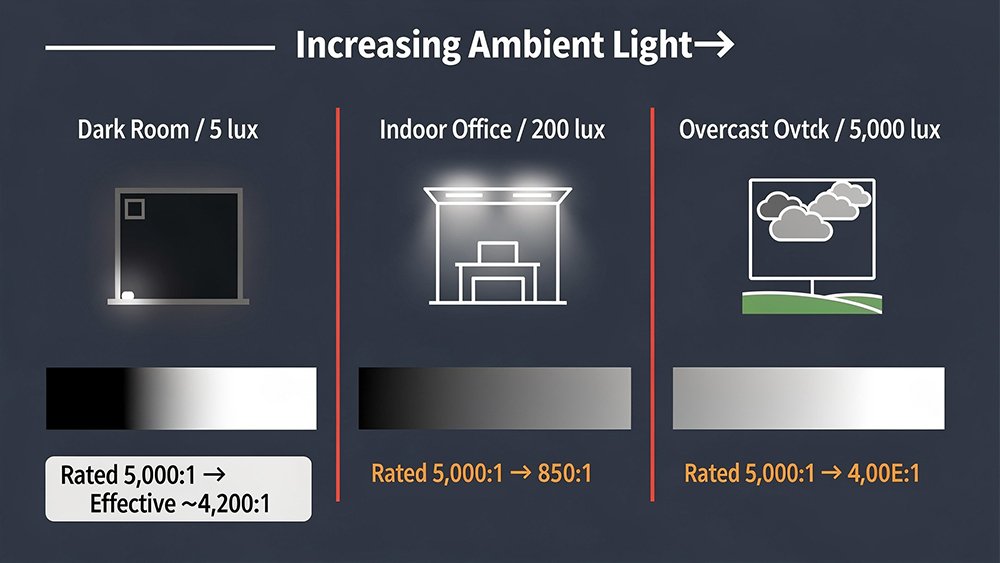
Real-world ambient contrast — same 5,000:1 rated panel: (Panel spec: 5,000 nit peak white / 1 nit black level)
| Lighting Condition | Ambient Light | Rated Static Contrast | Actual Effective Contrast |
|---|---|---|---|
| Dark room | 5 lux | 5,000:1 | ~4,200:1 |
| Indoor office | 200 lux | 5,000:1 | ~850:1 |
| Overcast outdoor | 5,000 lux | 5,000:1 | ~120:1 |
| Direct sunlight | 50,000 lux | 5,000:1 | ~18:1 |
A panel with a 5,000:1 spec installed under direct outdoor sunlight delivers approximately 18:1 effective contrast — at which point the rated contrast ratio figure is irrelevant. For outdoor LED displays, brightness (≥5,000 nit) and surface reflectance (≤3%) become the primary procurement specifications.
Surface Reflectance: The Hidden Contrast Multiplier
Surface reflectance determines how much ambient light bounces off the panel face and elevates the apparent black level. Lower reflectance = deeper perceived blacks = higher effective contrast ratio.
| Surface Reflectance | Panel Static Spec | Effective Contrast at 200 lux |
|---|---|---|
| Standard indoor (4.5–6.5%) | 1,000:1 | ~800:1 |
| Premium (≤3%) | 1,000:1 | ~920:1 |
COB-packaged LED modules achieve lower reflectance than traditional SMD packages by integrating the LED array under a flat, matte epoxy surface with no gaps between beads. This reduces inter-pixel reflection and raises ambient contrast performance by 30–50% compared to equivalent SMD specifications — both factors directly raise the effective contrast ratio under real operating conditions.
Choosing the Right Contrast Ratio
Application contrast ratio requirements vary by environment and content type — not by the highest number available at your budget.
The most reliable procurement rule: if a camera is present at any point during the display's operating life, raise the static contrast specification to 8,000:1 minimum. Camera sensors capture contrast artifacts — including banding and shadow stepping — that the human eye tolerates. A gradient that appears smooth to a live audience will show visible stepping at 1/1000s broadcast shutter speed, and no post-processing corrects it. Pairing static contrast with grayscale bit depth (14-bit minimum for broadcast) eliminates both failure modes simultaneously.
For outdoor installations, the contrast ratio vs brightness relationship inverts entirely: once ambient light exceeds 5,000 lux, brightness output and surface reflectance determine perceived image quality, not the rated contrast figure.
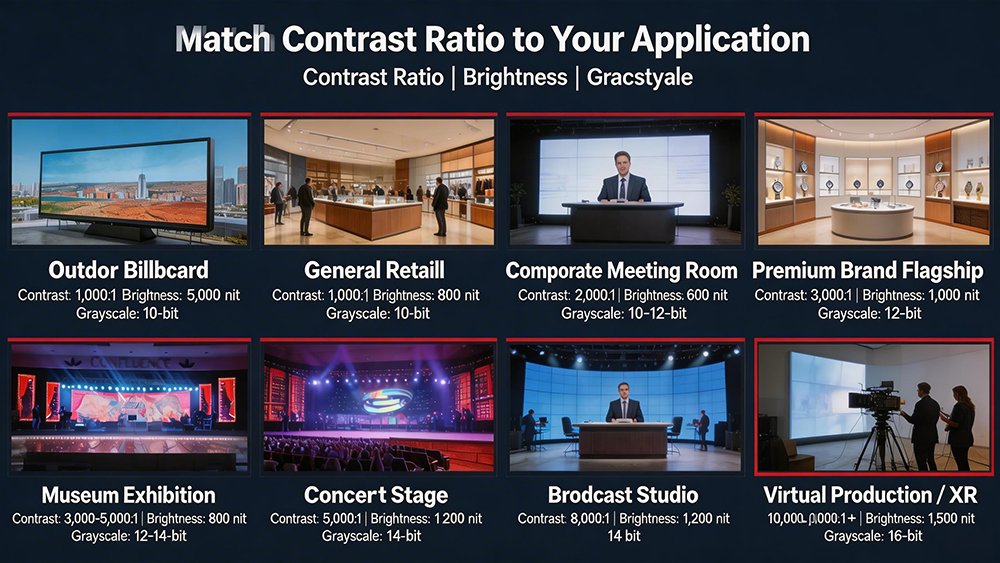
Three-parameter selection table — contrast, brightness, and grayscale together:
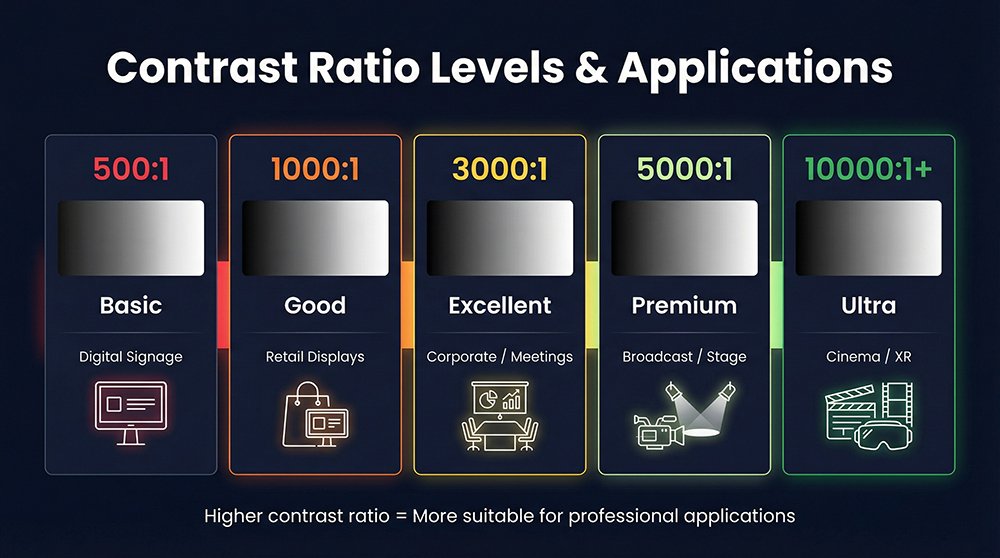
| Application | Min. Static Contrast | Min. Brightness | Min. Grayscale | Key Priority |
|---|---|---|---|---|
| Outdoor signage / billboard | 1,000:1 | 5,000 nit | 10-bit | Brightness first |
| General indoor retail | 1,000:1 | 800 nit | 10-bit | Cost balance |
| Corporate meeting room | 2,000:1 | 600 nit | 10–12-bit | Gradient accuracy |
| Premium brand / flagship store | 3,000:1 | 1,000 nit | 12-bit | Dark scene detail |
| Museum / cultural exhibition | 3,000:1–5,000:1 | 800 nit | 12–14-bit | Artwork fidelity |
| Concert stage / rental events | 5,000:1 | 1,200 nit | 14-bit | Camera-facing |
| Broadcast studio / TV set | 8,000:1 | 1,200 nit | 14-bit | Camera HDR pipeline |
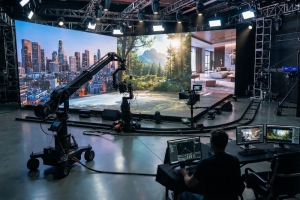
| Virtual production / XR stage | 10,000:1+ | 1,500 nit | 16-bit | ICVFX* on-camera |
*ICVFX = In-Camera Visual Effects — the on-camera LED volume workflow standard for virtual production.
Quick selection rule (copy directly into your RFP):
No camera on site → 1,000:1 static minimumCamera present at events → 5,000:1 static minimumBroadcast / VP application → 8,000:1–10,000:1+ staticOutdoor / direct sunlight → Brightness ≥5,000 nitsurface reflectance ≤3%Budget-constrained commercial → 1,000:1 static is the safe floor
How to Verify Contrast Ratio On Site
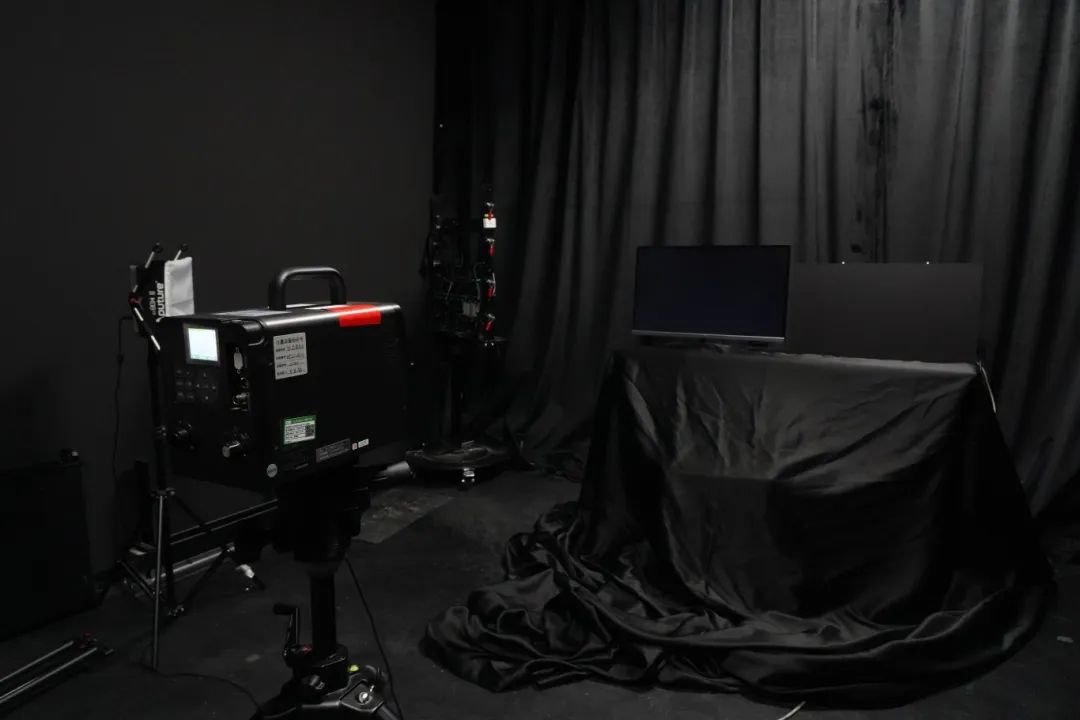
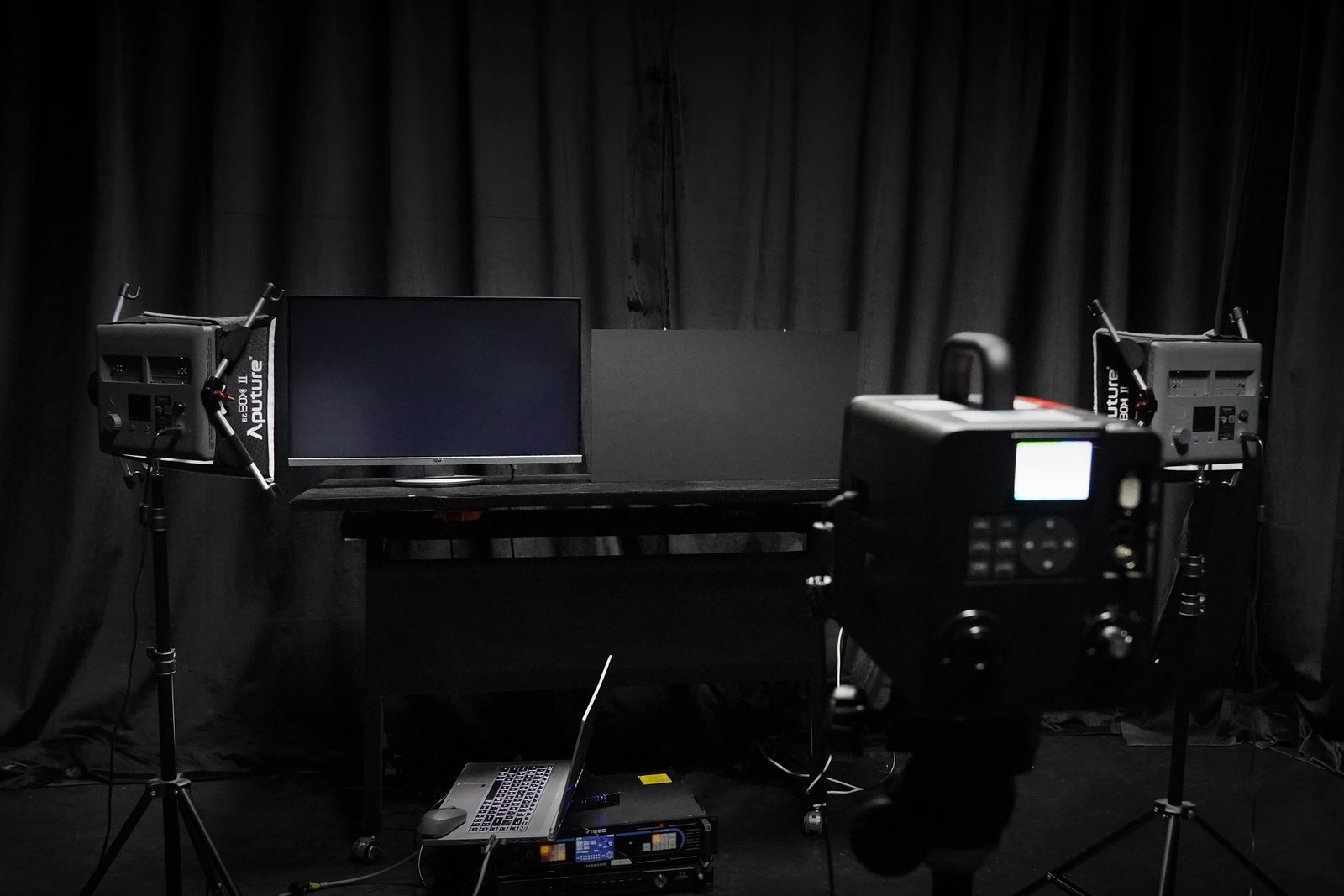
No datasheet number can be trusted until you verify it on delivered hardware — these three tests require no specialist equipment and complete in under 10 minutes.
Test 1 — Pure Black Screen Check
Display full-screen black content at rated brightness Inspect for grey wash, faint glow, or leakage from individual LED beads Any visible grey = LED bead leakage elevating minimum luminance → actual contrast ratio below specification Focus on panel edges and corners where leakage concentrates first
Test 2 — Gradient Pattern Check
Display a 0–100% black-to-white gradient test pattern at rated brightness Inspect the 0–20% brightness range — this mirrors the ANSI checkerboard test method and is where contrast limitations appear first Visible hard steps or colour blocks in this zone = contrast insufficient for dark-scene content A smooth, continuous transition through the full range confirms the static contrast spec is functioning
Test 3 — Dynamic Contrast Reveal Test
Rapidly switch between a full-screen black image and a full-screen white image Observe whether the display auto-adjusts brightness between the two states If the panel visibly dims on the black screen and brightens on the white screen, the quoted contrast ratio figure is dynamic, not static A panel with genuine static contrast maintains identical brightness settings regardless of content
Acceptance checklist for contrast sign-off:
□ Pure black screen: no grey wash, no pixel leakage visible□ Gradient pattern: no visible steps in the 0–20% brightness range□ Scene-switch test: no auto-brightness compensation detected□ Supplier confirms static contrast spec + test method in writing□ Measurement condition confirmed: 10 lux ambient (not darkroom)□ Surface reflectance spec provided (indoor: ≤6.5% / premium: ≤3%)
Frequently Asked Questions
Q: What does 1000:1 contrast ratio mean on an LED display? It means peak white luminance is exactly 1,000 times brighter than minimum black — measured at 10 lux ambient light per industry standard SJ/T 11281-2007. For general commercial installations with no camera present, 1000:1 static contrast is the minimum acceptable threshold for image quality that does not appear washed out.
Q: What is the difference between static and dynamic contrast ratio? Static contrast measures the white-to-black ratio within a single frame using hardware output only — this is the only reliable procurement specification. Dynamic contrast applies algorithmic brightness adjustment across frames, routinely inflating figures to 100,000:1 while the underlying static contrast remains below 1,000:1.
Q: What is a good contrast ratio for an LED display? Match the spec to your application: 1,000:1 static for general indoor and outdoor signage; 3,000:1–5,000:1 for premium retail and museum installations; 8,000:1–20,000:1 for broadcast studio and live event screens; 10,000:1 or above for virtual production and ICVFX volumes where a camera is always present.
Q: How does ambient light affect LED display contrast ratio? Significantly — a 5,000:1 panel in a 200 lux office environment delivers approximately 850:1 effective contrast. The same panel under direct outdoor sunlight at 50,000 lux drops to roughly 18:1. For outdoor LED displays, brightness (≥5,000 nit) and surface reflectance (≤3%) are the primary specifications, not the rated contrast ratio.
Q: Why does my high-contrast LED display still look washed out? Three causes account for over 90% of cases: the quoted figure is dynamic contrast rather than static; the driver IC operates below its rated specification; or ambient light in the installation environment reduces effective contrast by 60–80%. Display a full-screen black image on site — visible grey wash confirms the cause immediately.
Q: How do I verify LED display contrast ratio on site? Run three checks: display a full-screen black image and inspect for grey wash or pixel leakage; show a 0–100% gradient and check the 0–20% range for visible steps; rapidly switch between full-black and full-white content and observe whether the screen auto-adjusts brightness. Any auto-adjustment confirms a dynamic contrast specification, not static.
Not sure which contrast ratio spec fits your installation environment? Send us your application type, ambient light conditions, and whether a camera will be present — we will return a matched specification and product recommendation within 24 ho