

 English


ixel pitch is the millimeter distance between LED pixels. P1.2 means 1.2mm, P20 means 20mm. This single number is the core of your LED display project. It directly determines your minimum viewing distance, final image quality, and the total budget. Choosing the wrong pitch by just one step is a common and costly mistake. It can mean overpaying by 30–150% or delivering unusable image quality at your actual viewing distance.
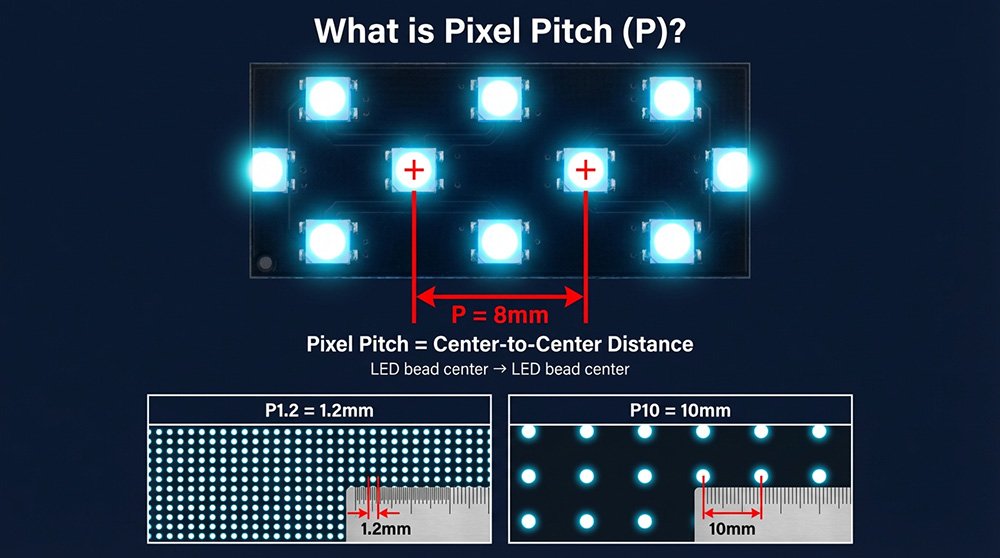
This comprehensive pixel pitch chart is your one-stop reference. It covers every standard pitch from P1.2 to P20 with a complete comparison table, a unified formula guide, a practical 3-step selector tool, and crucial regional adaptation notes for challenging environments like the Middle East and Northern Europe.
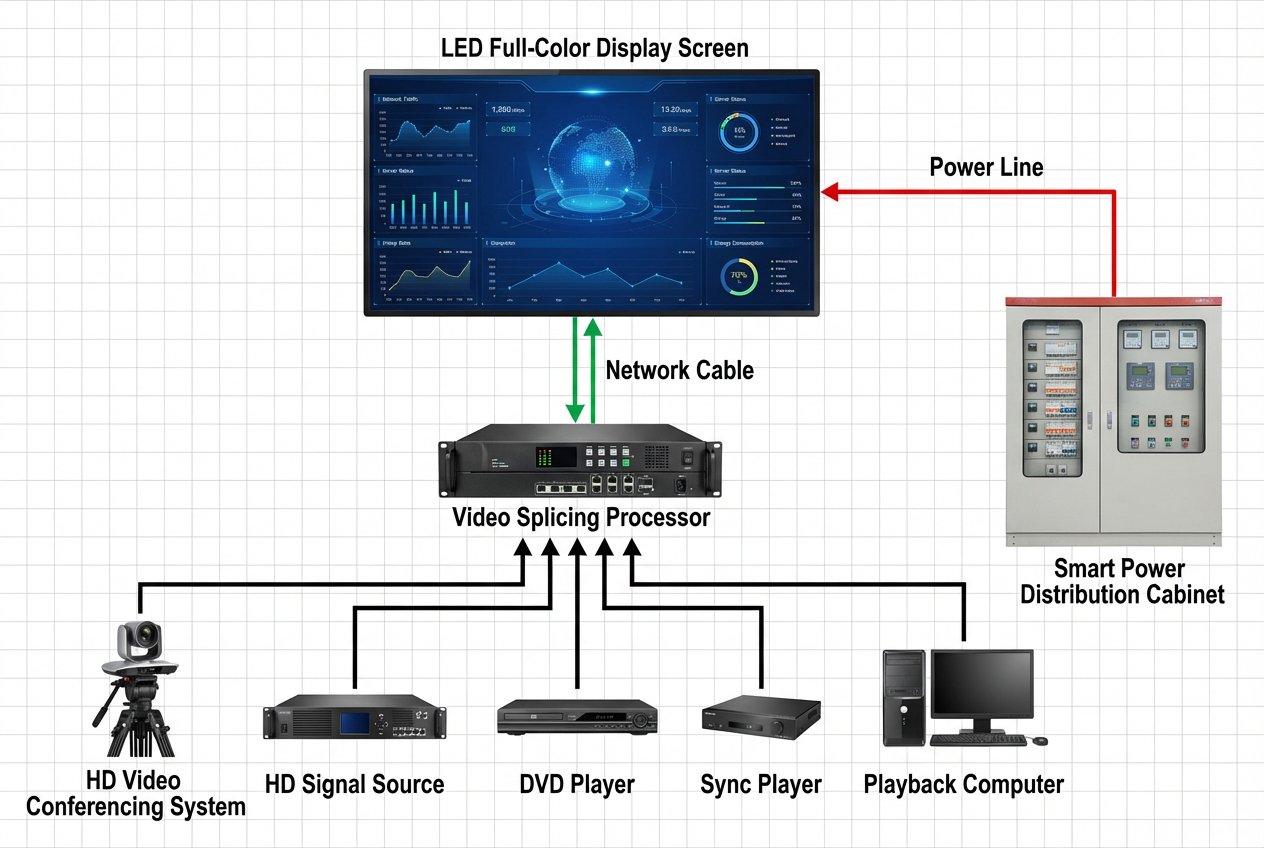
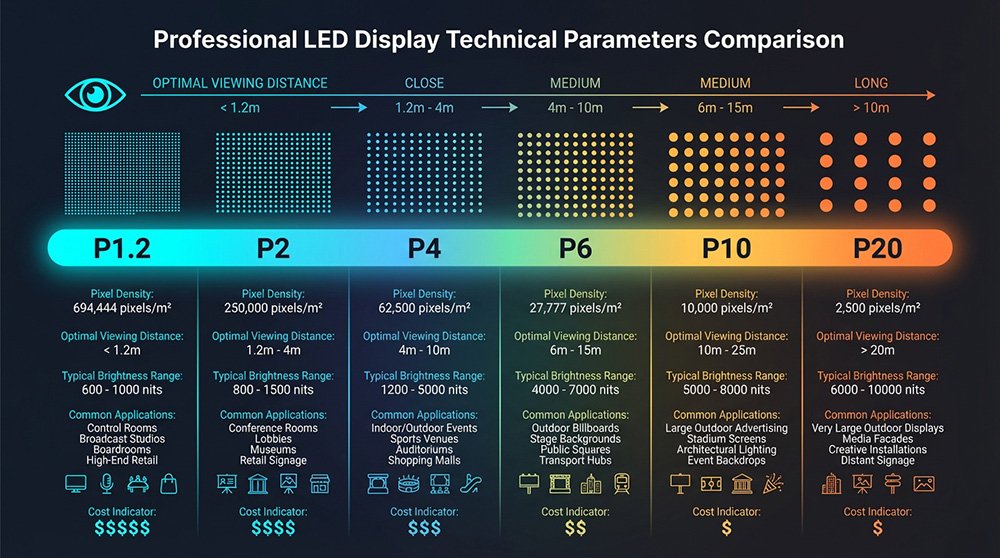
Quick Comparison: 5 Most Common Pitches
Before diving into the full 14-pitch table, use this quick reference to instantly identify your target range. For the complete pixel pitch comparison table covering P1.2 through P20, see the detailed section below.
| Spec | P1.5 | P2.5 | P4 | P6 | P10 |
|---|---|---|---|---|---|
| Pixel Pitch | 1.5 mm | 2.5 mm | 4 mm | 6 mm | 10 mm |
| Pixel Density | 444,444 px/m² | 160,000 px/m² | 62,500 px/m² | 27,778 px/m² | 10,000 px/m² |
| Min. Viewing Dist. | 1.5m / 4.9ft | 2.5m / 8.2ft | 4m / 13ft | 6m / 20ft | 10m / 33ft |
| Optimal Distance | 2.3–3m | 3.8–5m | 6–8m | 9–12m | 15–20m |
| Typical Brightness | 800–1,200 nits | 800–1,500 nits | 4,000–6,000 nits | 5,000–7,000 nits | 6,000–8,000 nits |
| Relative Price | ★★★★★ | ★★★☆☆ | ★★☆☆☆ | ★★☆☆☆ | ★☆☆☆☆ |
| Indoor / Outdoor | Indoor ✓ / Out ✗ | Indoor ✓ / Out ✗ | Both ✓ | Outdoor ✓ | Outdoor ✓ |
| Best Use Case | Boardroom, studio | Hotel lobby, stage | Retail, rental | Plaza, sports | Billboard, stadium |
1. Pixel Pitch Comparison Table: P1.2 to P20
The pixel pitch comparison table below is the only reference you need — 14 standard pitches in one place. Use it in two directions: scan left-to-right to understand any specific pitch, or scan the “Optimal Distance” column to find the pitch that matches your space.
Table A — Technical Parameters
| P Value | Pixel Density (px/m²) | Min. Distance (m/ft) | Optimal Distance (m) | Max. Distance (m) | Environment |
|---|---|---|---|---|---|
| P1.2 | 694,444 | 1.2m / 3.9ft | 1.8–2.4m | 36m | Indoor |
| P1.5 | 444,444 | 1.5m / 4.9ft | 2.3–3.0m | 45m | Indoor |
| P1.8 | 308,642 | 1.8m / 5.9ft | 2.7–3.6m | 54m | Indoor |
| P2 | 250,000 | 2.0m / 6.6ft | 3.0–4.0m | 60m | Indoor |
| P2.5 | 160,000 | 2.5m / 8.2ft | 3.8–5.0m | 75m | Indoor |
| P3 | 111,111 | 3.0m / 9.8ft | 4.5–6.0m | 90m | Indoor/Outdoor |
| P4 | 62,500 | 4.0m / 13ft | 6.0–8.0m | 120m | Both |
| P5 | 40,000 | 5.0m / 16ft | 7.5–10m | 150m | Outdoor |
| P6 | 27,778 | 6.0m / 20ft | 9.0–12m | 180m | Outdoor |
| P8 | 15,625 | 8.0m / 26ft | 12–16m | 240m | Outdoor |
| P10 | 10,000 | 10m / 33ft | 15–20m | 300m | Outdoor |
| P12 | 6,944 | 12m / 39ft | 18–24m | 360m | Outdoor |
| P16 | 3,906 | 16m / 52ft | 24–32m | 480m | Outdoor |
| P20 | 2,500 | 20m / 66ft | 30–40m | 600m | Outdoor |
Table B — Application & Selection Parameters
| P Value | Typical Application | Package Type | Price Grade |
|---|---|---|---|
| P1.2 | Broadcast studio, control room, high-end retail | COB (preferred) / GOB | ★★★★★ |
| P1.5 | Premium boardroom, showroom, virtual production | COB / SMD 1010 | ★★★★★ |
| P1.8 | Corporate lobby, flagship retail, conference hall | SMD 0808/1010 | ★★★★☆ |
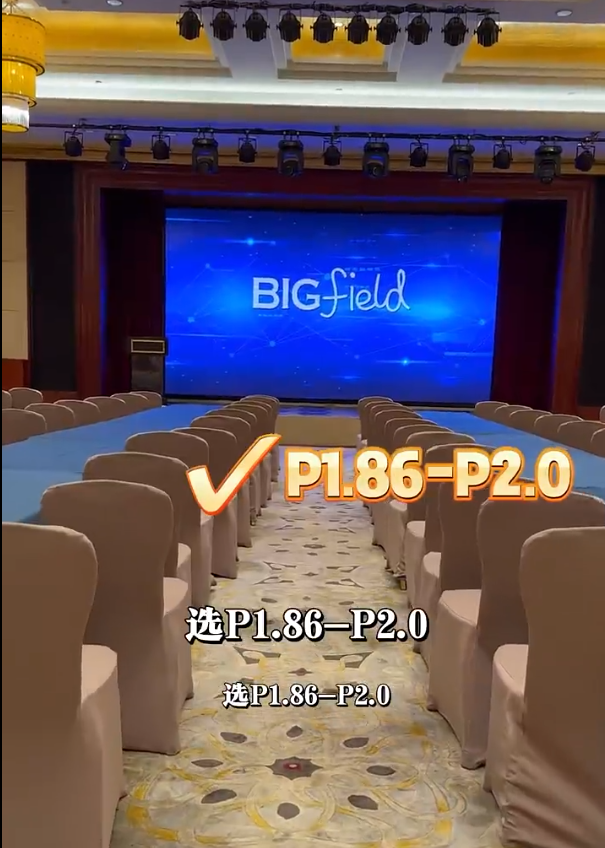
| P2 | Conference hall, exhibition, hotel lobby | SMD 1010/1212 | ★★★★☆ |
| P2.5 | Hotel lobby, stage backdrop, shopping mall | SMD 1212/1515 | ★★★☆☆ |
| P3 | Airport info screens, semi-outdoor corridors | SMD 1515 | ★★★☆☆ |
| P4 | Outdoor close range, rental events, retail facade | SMD 1515/2121 | ★★☆☆☆ |
| P5 | Building facade, concert stage, transport hub | SMD 2121 | ★★☆☆☆ |
| P6 | Sports venue, highway roadside, public square | SMD 2121 / DIP | ★★☆☆☆ |
| P8 | Urban billboard, industrial park, rooftop | DIP / SMD 2828 | ★☆☆☆☆ |
| P10 | Large billboard, stadium, parking guidance | DIP (preferred) | ★☆☆☆☆ |
| P12 | Stadium perimeter, overpass, industrial perimeter | DIP | ★☆☆☆☆ |
| P16 | Highway mega-billboard, port, mining site | DIP | ★☆☆☆☆ |
| P20 | Bridge advertising, landmark, ultra-long-range | DIP | ★☆☆☆☆ |
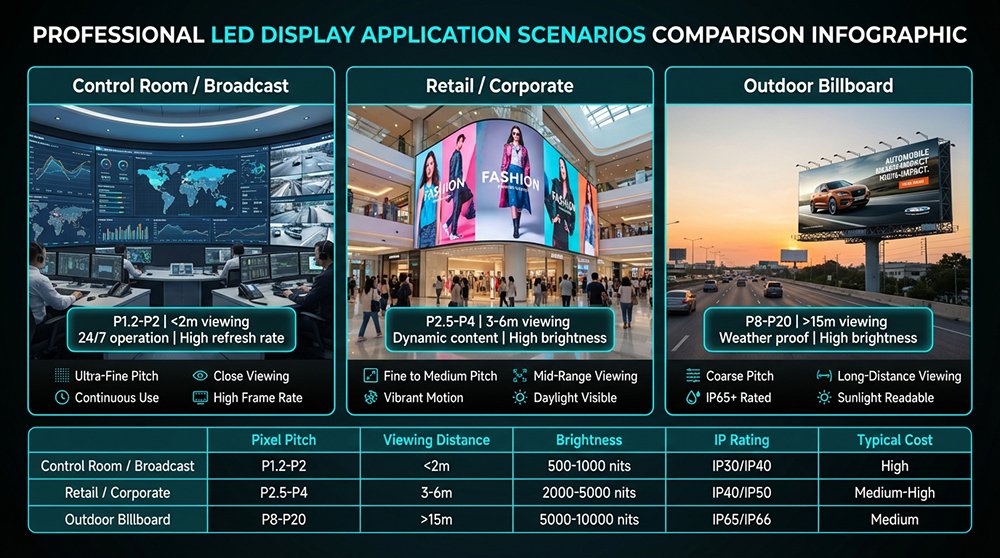
Four notes that matter:
Price grade is relative: P1.2 costs approximately 3–5× more per m² than P4, and 2–3× more than P2.5. Each 50% reduction in pixel pitch increases manufacturing cost by 80–120% due to exponentially higher pixel density. Optimal distance uses a comfort factor of ×1.5–2. For quick jobsite estimation, use the 10× foot rule (pitch in mm × 10 = minimum feet, ±30% accuracy). Outdoor pitches require 3,000–6,000 nits brightness for standard installations (up to 10,000 nits in high-irradiance regions like the Middle East). Indoor pitches typically run 800–1,500 nits. Remember, the same P4 panel cannot safely substitute for both environments. Package type matters: COB offers superior protection and color uniformity for fine-pitch indoor use. DIP provides the best weather resistance and repairability for large-pitch outdoor installations.
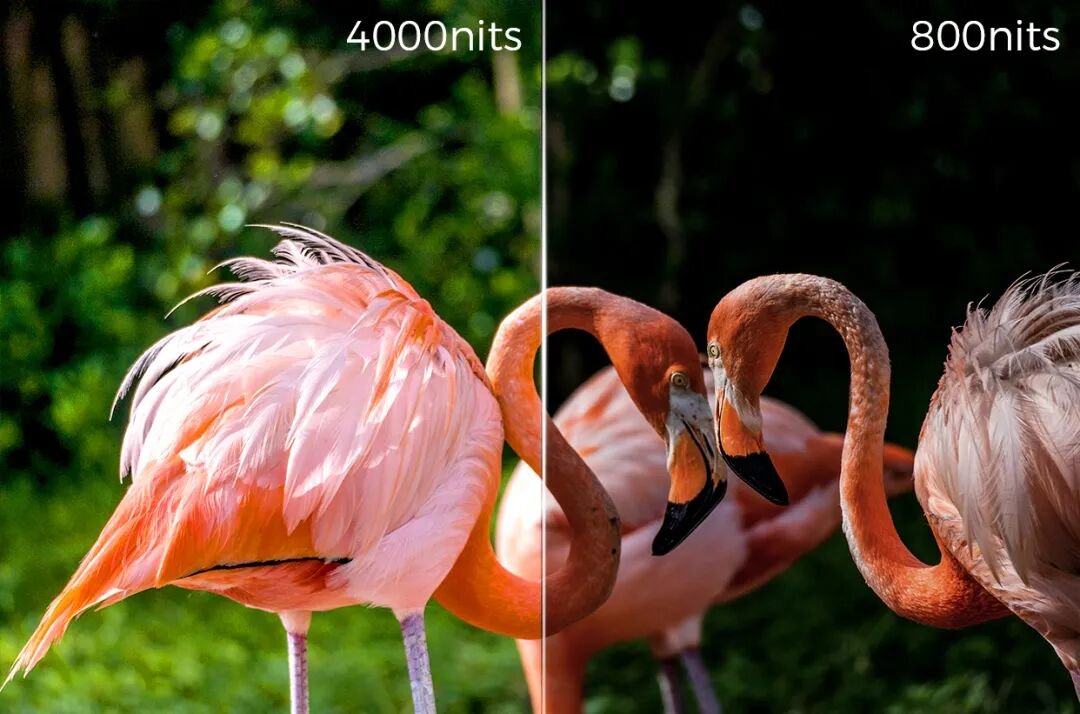
Brightness unit: nits = candelas per square meter (cd/m²). For reference: typical indoor ambient light is 200–500 nits; direct outdoor sunlight exceeds 10,000 nits.
2. Viewing Distance Formulas: Which One to Use
Here’s where things get tricky. Five different formulas exist for pixel pitch viewing distance. All are technically correct, but each solves a different problem. This is why supplier datasheets can show answers ranging from “1× pitch” to “30× pitch.”
| Formula Name | Multiplier | Origin | Use This When… |
|---|---|---|---|
| Color Blending Distance | ×0.5 | Physical threshold where RGB subpixels merge | Determining absolute closest physical position |
| Visual Acuity Distance | ×1 | Human 20/20 vision limit (1 arcminute resolution) | Setting minimum engineering distance in specs |
| Comfortable Viewing Distance | ×1.5–2 | Visual acuity + eye fatigue buffer factor | Designing retail, lobby, conference room installs |
| 10× Foot Rule | ×10 (ft) | AV industry field estimation rule of thumb | Fast jobsite or quotation estimates (±30% accuracy) |
| Maximum Viewing Distance | ×30 | Limit at which text remains legible | Planning maximum advertising coverage area |
For precision specification, use the engineering formula:
Pitch (mm) = Viewing Distance (m) × 1,000 ÷ 3,438
Quick version: Distance (m) ÷ 3.438 = Pitch (mm)
This derives from human 20/20 vision resolution (1 arcminute minimum angle). Example: a 5m conference room → 5,000 ÷ 3,438 = 1.45mm → select P1.2, not P1.5 (P1.5 leaves no safety margin at that distance).
The practical takeaway:
Use ×2 (meters) for interior permanent installations — the most widely accepted industry standard. Use ×10 (feet) on a jobsite when you need a 10-second answer. Use the engineering formula when specifying broadcast studios or control rooms with fixed close-observer positions.
The confusion arises because suppliers quote whichever formula makes their product look best. A supplier selling P4 for a 5m installation cites ×1 (passes at 4m minimum). A competitor cites ×2 (fails — recommends P2.5). Both numbers are mathematically real. The formula selection is the variable — always ask your supplier which formula they applied.
3. 3-Step Pixel Pitch Selector — Start From Your Space
Every guide on the market starts with the pixel pitch and works forward. This section works backwards: start with your physical space and get a pitch recommendation in three steps.
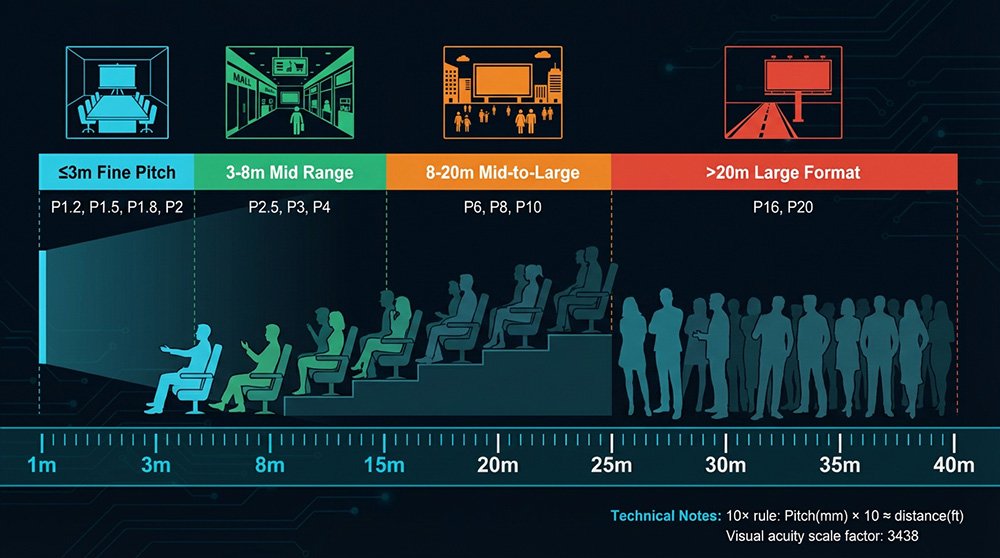
Step 1 — Measure your primary viewing distance
This is the distance from the screen to where most of your audience stands or sits — not the furthest point in the room.
≤ 3m → Fine Pitch zone: P1.2 / P1.5 / P1.8 3–8m → Mid Range zone: P2 / P2.5 / P3 8–20m → Mid-to-Large zone: P4 / P5 / P6 > 20m → Large Format zone: P8 / P10 / P12–P20
Step 2 — Confirm your installation environment
Indoor: Keep the Step 1 recommendation as-is. Outdoor (direct sunlight): Move up one pitch size — e.g., P2.5 → P3. Outdoor screens require 3,000+ nits; a larger pitch achieves this more efficiently with better thermal management.
Step 3 — Apply the budget rule
Within the range from Steps 1–2, select the largest pitch value that still meets your distance requirement. Choosing P1.8 for a 6m conference room adds 60–80% to hardware cost. Seated attendees beyond 3m see zero visible difference. That budget is better spent on a larger screen area or a brightness upgrade.
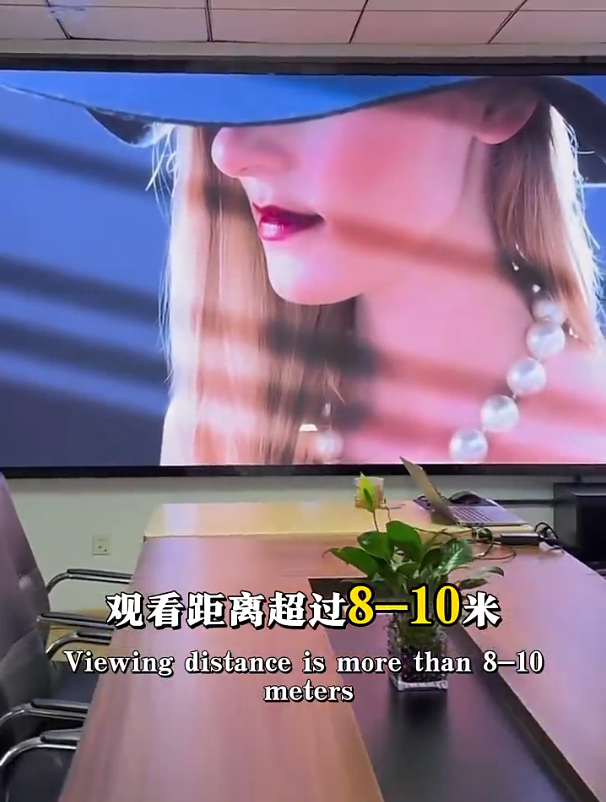
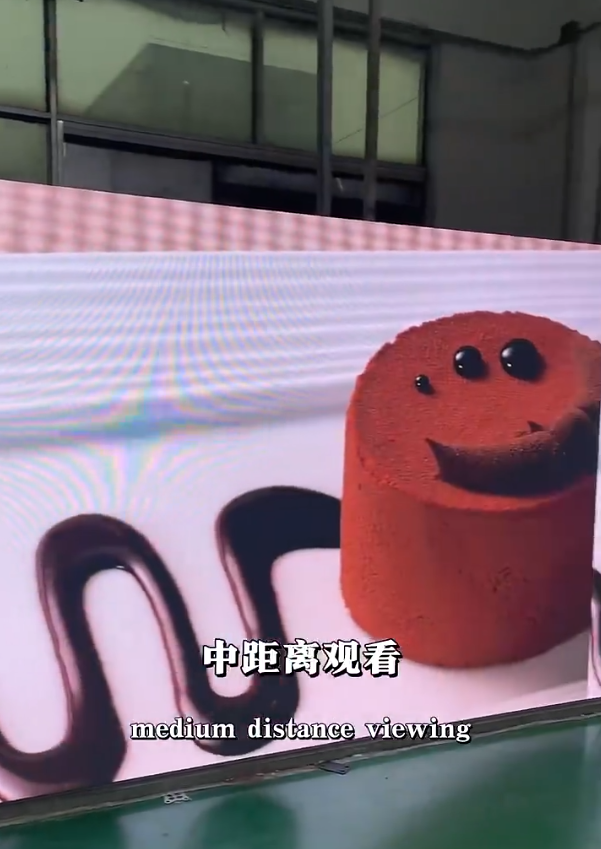
Common space quick-reference:
| Space Type | Typical Viewing Distance | Recommended Pitch |
|---|---|---|
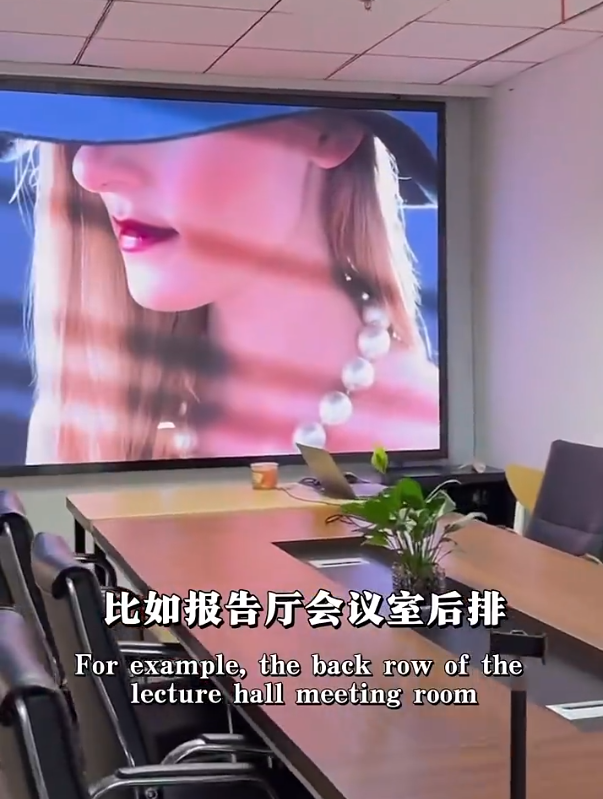
| Small conference room (≤ 20 seats) | 2–4m | P1.8–P2.5 |
| Corporate lobby / reception | 3–8m | P2.5–P4 |
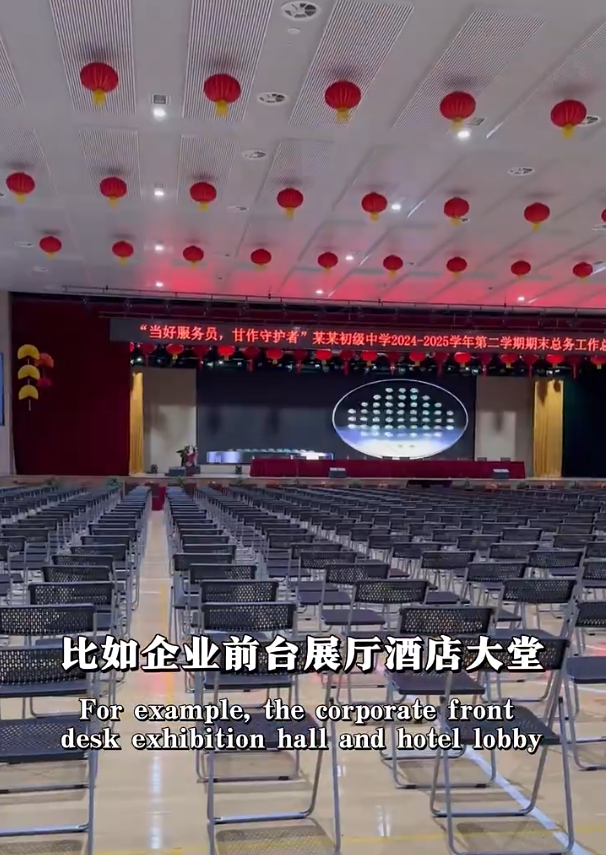
| Exhibition hall / museum | 3–10m | P2–P5 |
| Shopping mall atrium | 8–20m | P4–P8 |
| Outdoor building facade | 10–30m | P6–P10 |
| Highway billboard | > 30m | P16–P20 |
Whether you’re specifying an LED video wall for a corporate environment or selecting outdoor panels for a billboard network, this pixel pitch chart gives you a single verified reference to check any supplier recommendation.
4. Large Pitch Displays — P10 to P20 Application Guide
Most pixel pitch guides stop at P10. That’s a mistake. It leaves out the entire category of high-volume outdoor installations where P12 through P20 are the industry-standard choice. Defaulting to P10 here means significantly overpaying.
Beyond 20m viewing distance, the human eye cannot resolve the difference between P10 and P20. The visible quality is identical. The cost difference is not.
| Pitch | Primary Application | Typical Install Height | Content Type | Cost vs P10 |
|---|---|---|---|---|
| P10 | Sports stadium, large plaza | 5–15m | Video, full-motion graphics | Baseline |
| P12 | Stadium perimeter boards | 5–15m | Sponsor logos, dynamic text | ~25% lower |
| P16 | Highway, bridge advertising | 8–20m | Brand image, simple text | ~45% lower |
| P20 | Port, airport remote zones, building wrap | 15–40m | Minimal graphics, brand color | ~60% lower |
Three questions that determine P10 vs P12–P20:
Will content include fine text or small logos? If yes, stay at P10. If no, P12 or P16 delivers identical perceived quality at lower cost. Is the minimum viewing distance reliably above 15m? If yes, P12 matches P10 image quality at 75% of the hardware cost. Is the installation area over 200m²? Switching from P10 to P16 on a 200m² installation can reduce hardware spend by $40,000–80,000 (based on a $200–400/m² price differential) with no visible quality trade-off.
5. International Project Guide: Regional & Compliance Reference
Standard charts don’t account for climate extremes or export requirements. This section covers two common high-value international project environments and key certifications.
Middle East — High Temperature & Intense Sunlight
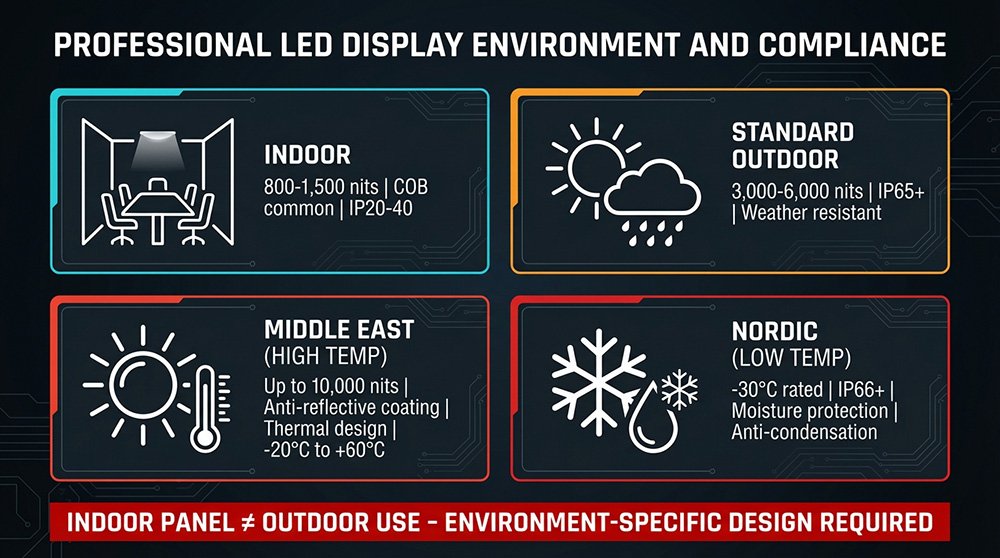
Ambient temperatures of 40–50°C and solar irradiance above 1,000 W/m² require active adaptation. Always spec brightness 20% above the minimums listed below — heat causes nit output degradation of 10–15% over the first year.
| Distance Range | Recommended Pitch | Key Adaptations |
|---|---|---|
| Semi-outdoor (corridors / canopies) | P3 | 4,000–5,000 nits, IP65, shade + basic cooling |
| 4–20m (close outdoor) | P4 | 8,000–10,000 nits, IP65+, anti-reflective coating, die-cast aluminum heatsink, common-cathode driver |
| 5–25m (mid-range outdoor) | P5 | 7,000–8,000 nits, UV-resistant coating, high-efficiency thermal module |
| 6–30m (highway / plaza) | P6 | ≥6,000 nits, IP65, basic thermal treatment sufficient |
| 8–40m (main road / industrial) | P8 | ≥5,000 nits, DIP encapsulation preferred for sustained heat resistance |
Core principle: DIP encapsulation outperforms SMD above P6 in sustained high-temperature outdoor environments. Anti-reflective coating is not optional — direct sunlight at 1,000 W/m² reduces effective contrast by up to 60% without it.
 Northern Europe — Low Temperature & High Humidity
Operating temperatures down to -30°C and persistent humidity above 80% require freeze-resistant construction. IP66+ weatherproofing is the minimum standard for all permanent outdoor installations here.
| Application | Recommended Pitch | Key Adaptations |
|---|---|---|
| Indoor premium (boardroom, command center) | P1.2–P2.5 | COB encapsulation, IP55+, stable to -10°C, anti-oxidation treatment |
| Indoor mid-range (auditorium, exhibition) | P3 | SMD 1515, IP55, rated to -10°C |
| Outdoor near-range (12–40m, rooftop / campus) | P8 | DIP or GOB, IP66+, rated to -30°C, freeze-resistant sealing |
| Outdoor mid-range (10–50m, parking / port) | P10 | DIP, IP66+, -30°C, moisture-proof module |
| Outdoor long-range (12–80m, industrial / highway) | P12 / P16 | DIP, IP66, -30°C, freeze-crack-resistant modules |
| Outdoor extreme (20–100m, bridge / landmark) | P20 | DIP, IP66+, -25°C, anti-freeze power supply required |
Core principle: COB encapsulation eliminates individual LED oxidation from condensation cycles. This is a common failure mode for SMD packages in high-humidity environments, often occurring within 18–36 months of outdoor exposure.
Compliance & Certification Reference
| Market | Required Certifications | Notes |
|---|---|---|
| European Union | CE + RoHS | Mandatory for all LED products; outdoor installations require additional IP protection test report |
| United States / Canada | ETL or UL | ETL is more common for LED displays; required for all commercial installations |
| Middle East (most markets) | CE + RoHS as baseline | Saudi Arabia / UAE may additionally require SASO / ESMA local certification |
| All other markets | CE + RoHS + IP test report | Covers 80%+ of international procurement requirements |
Three compliance mistakes that fail inspections:
Specifying IP65 for permanent outdoor installation in Northern Europe — IP66 is the correct minimum for freeze-thaw cycle environments. Shipping without RoHS documentation — EU customs holds shipments without full RoHS test reports regardless of CE marking on the unit. Using an indoor-rated panel (IP40–IP54) in a semi-outdoor application — humid semi-outdoor corridors and canopies require minimum IP65.
FAQ: Pixel Pitch Chart — Common Questions Answered
Q1: How do I calculate pixel pitch for a conference room or any indoor space? Use the engineering formula: Pitch (mm) = Distance (m) ÷ 3.438. A 5m room → 1.45mm → select P1.2. For quick estimation, divide distance by 1–2 (5m → P2.5–P5). Most conference rooms (3–6m) are best served by P1.8–P2.5. P1.2 adds 40–80% to cost with no visible benefit for attendees beyond 3m.
Q2: How much more expensive is fine pitch vs standard pitch? P1.2 costs approximately 3–5× more per m² than P4, and 2–3× more than P2.5. Each 50% reduction in pixel pitch increases hardware cost by 80–120%, driven by exponentially higher pixel density in manufacturing.
Q3: Which pixel pitch is standard for outdoor LED billboards? P6 to P10 covers urban outdoor billboards at 8–20m. P16 and P20 are standard for highway installations above 30m. Fine-pitch panels below P4 are not suitable outdoors — their 800–1,500 nit output becomes invisible in direct sunlight, which requires 3,000–6,000 nits minimum.
Q4: Why does my supplier quote a different viewing distance than this chart? Suppliers select whichever of the five formulas makes their product appear most suitable. The ×1 formula (visual acuity minimum) and ×2 formula (comfortable viewing) differ by 100% — both are valid, but serve different design objectives. Always ask which formula your supplier applied before accepting a recommendation.
Q5: What is the difference between P1.2 and P2.5 LED displays? P1.2 has 4× the pixel density of P2.5 (694,444 vs 160,000 px/m²) and costs 2–3× more. Beyond 5m, the visible difference disappears entirely — P2.5 delivers equivalent image quality at 50–65% lower cost per square meter.
Q6: Can I use an indoor LED screen outdoors temporarily? No. Indoor panels are rated at 800–1,500 nits — invisible in direct sunlight (3,000–6,000 nits required). Outdoor environments require IP65+ weatherproofing; most indoor panels are rated IP40–IP54. Using indoor panels outdoors voids warranty and risks permanent water damage within a single weather event.